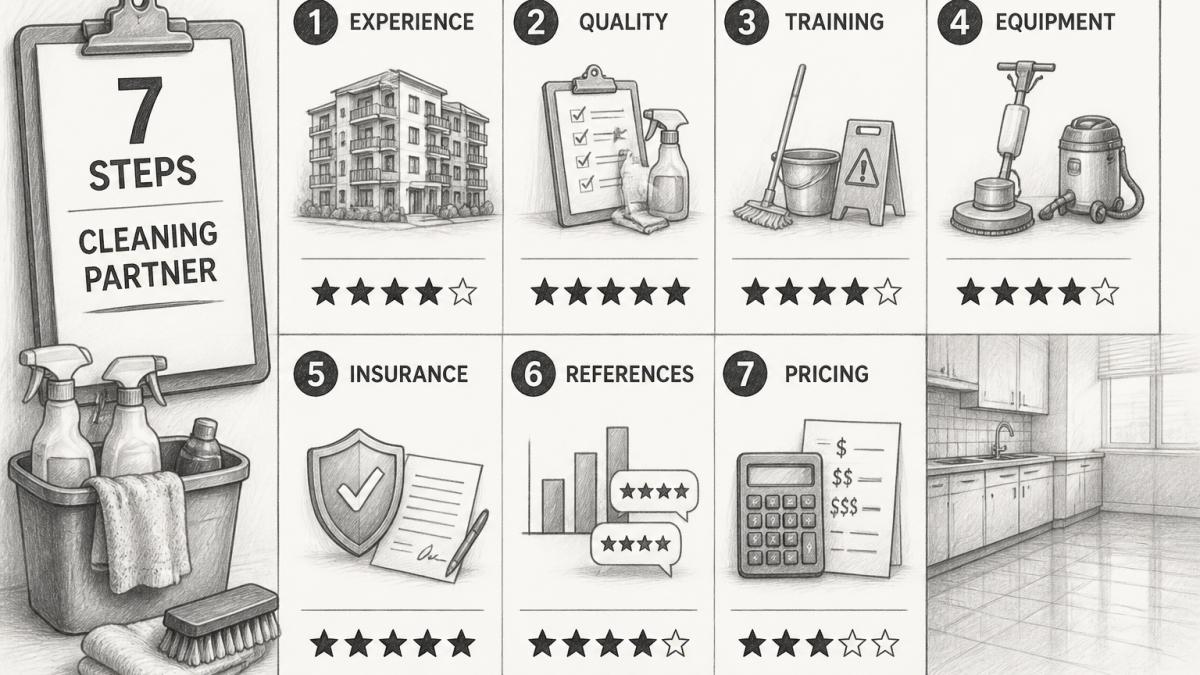
 listicle
Choosing a Reliable Cleaning Partner: 7 Vendor Vetting Steps
Table of Contents
- Start With a Site Assessment and a Commercial Cleaning Service Vetting Checklist
- Key Questions to Ask Janitorial Service Providers Before You Sign
- Verify Insurance, Bonding, and Background Checks Before Work Begins
- Cleaning Service Contract Best Practices: Scope, Pricing, and Exit Terms
- Evaluate Technology, Green Certification, and Communication Hierarchy
- Red Flags When Choosing a Reliable Cleaning Partner
- Frequently Asked Questions
Last Updated: September 28, 2026
Start With a Site Assessment and a Commercial Cleaning Service Vetting Checklist
Choosing a reliable cleaning partner starts with a walkthrough of your property and a written vetting checklist that forces every vendor to answer the same questions. At Squeaky Clean Plus, we have watched property teams skip this step and pay for it later with missed turnovers and lost rent.
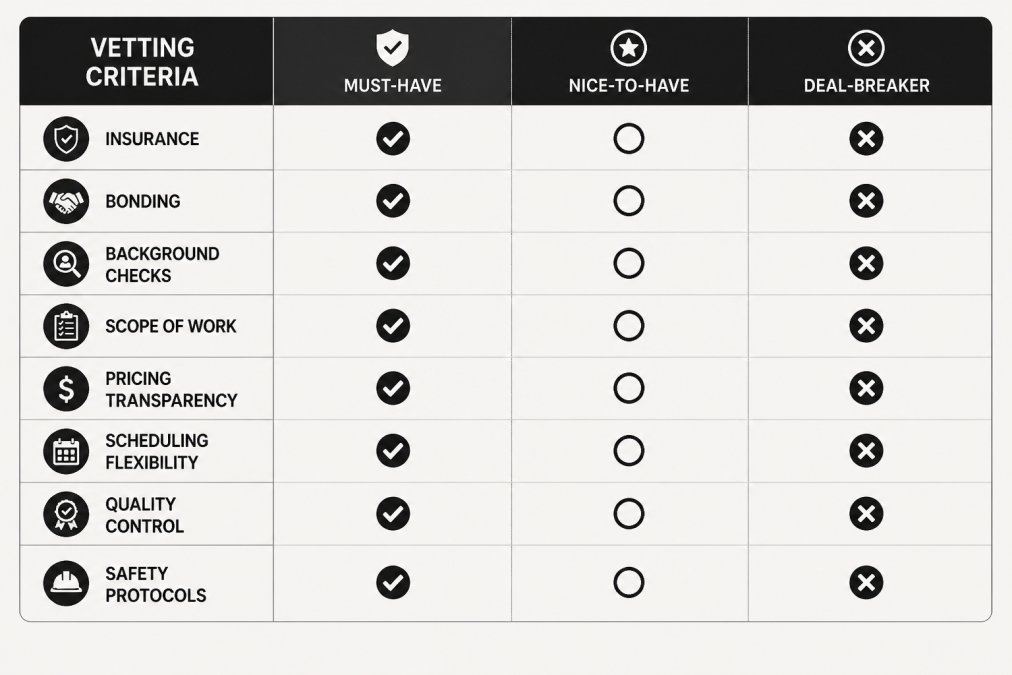
What Belongs on Your Vetting Checklist
Score each vendor from one to five on the eight criteria above, weighting what matters most to your portfolio. If you run apartment turnovers on a 48-hour clock, scheduling flexibility and staffing depth should outweigh a polished sales presentation.
Why a Walkthrough Beats a Phone Quote
A phone quote is a guess; a walkthrough is an assessment. Vendors who insist on seeing the site before quoting price more accurately and flag issues early, from stained carpet in unit 204 to construction dust coating every vent.
Key Questions to Ask Janitorial Service Providers Before You Sign
The right questions to ask janitorial service providers expose how a company actually operates, not how it markets itself. Ask about staffing models, turnover, supervision, and what happens when a crew member calls in sick on your biggest turnover day.
Questions That Expose Scheduling and Staffing Gaps
- How many crews serve this area, and how many units can you absorb in a 48-hour window?
- Are cleaners direct employees or subcontractors?
- Who supervises the crew on site, and how often does a manager inspect finished work?
- What is your employee turnover rate, and how do you train new hires?
- What happens if a scheduled crew does not show?
Vague answers signal a vendor that will leave you juggling schedules. A dependable cleaning partner answers with specifics: crew counts, supervisor names, and backup plans.
Verify Insurance, Bonding, and Background Checks Before Work Begins
Insurance, bonding, and background checks separate professional janitorial services from casual operators. Request certificates before any crew sets foot on your property, and verify them directly with the insurer or bonding company rather than accepting a photocopy.
Cleaning Service Contract Best Practices: Scope, Pricing, and Exit Terms
Cleaning service contract best practices come down to three things: a detailed statement of work, transparent pricing, and a clear exit path. Contracts that leave any of these vague create disputes later, usually at the worst possible moment.
Request Walk Thru Estimate Today →
What a Statement of Work Should Cover
The statement of work defines exactly what gets cleaned, how often, and to what standard. It should list every task by area, from unit interiors and appliance cleaning to common areas and post-construction debris removal. Include frequency, timing windows, and the inspection process for completed work.
| Contract Element | What to Specify | Why It Matters |
|---|---|---|
| Service scope | Tasks per area, frequency, standards | Prevents "that wasn't included" disputes |
| Pricing model | Per-unit, per-project, or recurring rate | Keeps invoices predictable |
| Performance metrics | Inspection scores, re-clean windows | Creates accountability |
| Termination terms | Notice period, exit conditions | Protects you if quality slips |
| Supply responsibility | Who provides chemicals, equipment, trash liners | Avoids mid-job supply gaps |
| Access and keys | Key control, alarm codes, lockbox protocol | Protects resident and property security |
Pricing Models and What They Hide
Three pricing structures dominate the market, each hiding costs differently:
- Per-unit flat rate. Predictable for turnover work, but vendors often pad the rate to absorb worst-case units. Ask what happens when a unit takes twice as long as expected, a flat rate should mean the vendor absorbs that risk, not you.
- Per-hour or per-labor-hour. Transparent on paper, but hours expand when supervision is weak. Require a not-to-exceed cap per unit or per visit.
- Per-square-foot recurring rate. Common for common-area janitorial. Watch for exclusions: high-dust areas, restroom restocking, and floor care (strip, wax, burnish) are frequently billed as add-ons.
Termination Clauses and Notice Periods
Negotiate a trial period covering the first batch of units with a quality review before full commitment. A fair termination clause runs 30 to 60 days with written notice and should never penalize you for documented performance failures. If a vendor refuses any exit flexibility, that tells you how confident they are in their own service.
Exit Strategy: What to Do When the Partner Fails
Most guides stop at the termination clause. The harder question is what happens operationally on the day you invoke it. Build an exit plan into the contract itself:
- Key and access return. Specify a deadline (commonly 5 business days) for return of all keys, fobs, alarm codes, and lockbox contents, with a signed inventory.
- Supply and equipment retrieval. If the vendor stored equipment or chemicals on site, define who removes them and by when.
- Transition of records. Require turnover of inspection reports, photo documentation, and any work-order history the vendor generated. This protects you if a resident or owner disputes a unit's condition after the switch.
- Final invoice and dispute window. Set a fixed window (30 days is common) for final invoicing and a process for disputing charges tied to documented performance failures.
- Non-disparagement and reference neutrality. Avoid clauses that prevent you from giving an honest reference; they cut both ways and rarely benefit the client.
Performance Metrics That Trigger Exit Rights
Tie your exit rights to measurable triggers, not subjective dissatisfaction:
- Two or more missed turnover windows in a rolling 30-day period
- Inspection scores below an agreed threshold on two consecutive audits
- Failure to produce a replacement crew within a defined response window after a no-show
- Lapse in insurance or bonding coverage without notice
Evaluate Technology, Green Certification, and Communication Hierarchy
Modern facility management runs on more than mops and spray bottles. Three areas deserve their own line of questioning: technology integration, verified green certification, and a written communication hierarchy.
Technology Integration: What to Ask and Why It Matters
Technology integration is where many local vendors fall behind national providers, and the fastest way to tell whether a partner can prove reliability or only promise it. Ask about four capabilities:
- Digital work orders. Can the vendor receive, assign, and close work orders through a system you can access, or does everything route through a phone call and a text thread?
- Photo documentation. Are before-and-after photos captured per unit or per visit and stored against the work order? Photo records are the single most useful artifact when a resident or owner disputes a unit's condition.
- Real-time reporting. Can you see completion status during a turnover window, or do you learn about a missed unit when the leasing agent walks in?
- Calendar integration. Does the vendor's scheduling system sync with your turnover calendar, or does someone manually re-key dates each week?
Green Certification: How to Tell Real From Greenwashing
Green certification matters, especially for properties marketing to eco-conscious tenants, but the market is full of claims that do not survive a document check. These steps separate the two.
- Ask for the actual product list, not a category. "Eco-friendly supplies" is a marketing phrase. A product list with manufacturer names and product codes is a verifiable claim.
- Check third-party certifications on the products themselves. Look for recognized certifications such as Green Seal, UL ECOLOGO, or the EPA Safer Choice program label. Each maintains a searchable list of certified products you can check against the vendor's supply list.
- Distinguish product certification from company certification. A vendor may use certified products while operating no certified processes. Ask whether the company itself holds any certification, and if so, which body issued it and when it expires.
- Ask about dilution and dispensing systems. Concentrated products dispensed through measured systems reduce packaging and chemical waste. Vendors using pre-diluted ready-to-use bottles often claim green status without the operational practices behind it.
- Request disposal and waste-handling practices in writing. How the vendor handles used solutions, packaging, and debris is part of the environmental footprint and rarely appears in marketing materials.
Communication Hierarchy: One Number for 5 p.m. Friday
Communication hierarchy is the piece most property managers learn about the hard way. Insist on a named account contact, an escalation path for after-hours problems, and a written response-time commitment. When a turnover goes sideways at 5 p.m. on a Friday, you need one phone number, not a general inbox.
Request Walk Thru Estimate Today →
| Tier | Use For | Contact Type | Response Commitment |
|---|---|---|---|
| Routine | Scheduling, supply requests, non-urgent questions | Named account manager | Next business day |
| Urgent | Same-day turnover issues, access problems, no-shows | Account manager plus on-call supervisor | Within 2 hours during business hours |
| Emergency | Property damage, safety incident, after-hours lockout | On-call supervisor with direct mobile | Within 30 minutes, 24/7 |
Red Flags When Choosing a Reliable Cleaning Partner
Red flags cluster around three themes: evasion, inconsistency, and pressure. A vendor who will not provide certificates, cannot name a supervisor, or pushes for a long contract without a trial period is showing you how the relationship will run.
Watch for these specific warning signs:
- Quotes given without a site visit or walkthrough
- No written statement of work, only verbal promises
- Reluctance to share insurance or bonding documents
- High employee turnover with no training program described
- Pressure to sign a multi-year agreement immediately
- No named point of contact or escalation process
- Invoices that vary widely without explanation
The strongest signal of a reliable cleaning partner is not price or polish. It is willingness to be measured: documented scope, named contacts, verified insurance, and a trial period with real quality checks.
Frequently Asked Questions
What should I look for when hiring a commercial cleaning service?
Look for proof of general liability insurance and bonding, documented background checks for every crew member, and a written statement of work that lists exact tasks and frequencies. Ask for two or three references from similar properties and confirm they can meet your turnover window. A reliable cleaning partner will also name a dedicated point of contact and provide a quality control process, not just a price per unit.
What questions should I ask a potential cleaning partner before signing a contract?
Ask how they handle staff turnover and whether the same crew returns each visit. Ask what happens when a scheduled cleaning is missed and how quickly they respond. Ask who supervises on-site and how you report problems. Ask whether they carry liability insurance and bonding, and request a certificate. Finally, ask about termination terms: notice period, final walkthrough, and any fees for ending the contract early.
How can I ensure a cleaning partner meets property turnover deadlines?
Put the deadline in the statement of work with a specific window, such as 48 hours from move-out to show-ready. Ask the vendor to confirm crew size and start time in writing before each turnover. Set up a check-in text or email when the crew arrives and when they finish. Track on-time completion over the first 30 days. If they miss twice in a month, treat it as a performance issue and escalate through your contract's accountability clause.
What are the red flags to avoid when selecting a cleaning service?
Walk away if the vendor cannot provide a certificate of insurance or bonding, refuses to name the crew assigned to your property, or quotes a price without a site visit. Other red flags include no written scope of work, no process for reporting damage or missed areas, and pressure to sign a long contract with no trial period. A vendor who cannot answer basic questions about scheduling or supervision will likely miss deadlines.
How do I verify the reliability of a professional cleaning company?
Check that the company is registered with your state and carries active liability insurance and bonding. Call references from properties similar in size and type to yours. Ask those references about on-time rates, how quickly issues were resolved, and whether they renewed the contract. Request a trial period of 30 days on a small number of units. A company confident in its service will agree to a trial and a written performance standard.