 listicle
Why Professional Turnover Cleaning Saves Money
Table of Contents
- The Real Cost of Vacancy: How Turnover Cleaning Protects Revenue
- Average Cost of Apartment Turnover Cleaning: What You Are Actually Paying For
- In-House vs. Outsourced: The Hidden Costs of Managing Cleaning Staff
- How to Reduce Vacancy Time Between Tenants with Professional Cleaning
- Your Apartment Turnover Checklist: Standardizing for Savings
- Two Angles Competitors Miss: Tax Deductions and Insurance Premiums
- Conclusion: Treating Turnover Cleaning as a Capital Investment
- Frequently Asked Questions
Last Updated: September 30, 2026
The Real Cost of Vacancy: How Turnover Cleaning Protects Revenue
An empty unit is the most expensive thing a property manager owns. Every day a unit sits vacant, you lose rent you will never recover, and the cleaning decisions you make during that window directly determine how long the loss continues. This guide from Squeaky Clean Plus explains why professional turnover cleaning saves money by shortening vacancies, protecting assets, and cutting the hidden costs that rarely show up on a cleaning invoice.
Average Cost of Apartment Turnover Cleaning: What You Are Actually Paying For
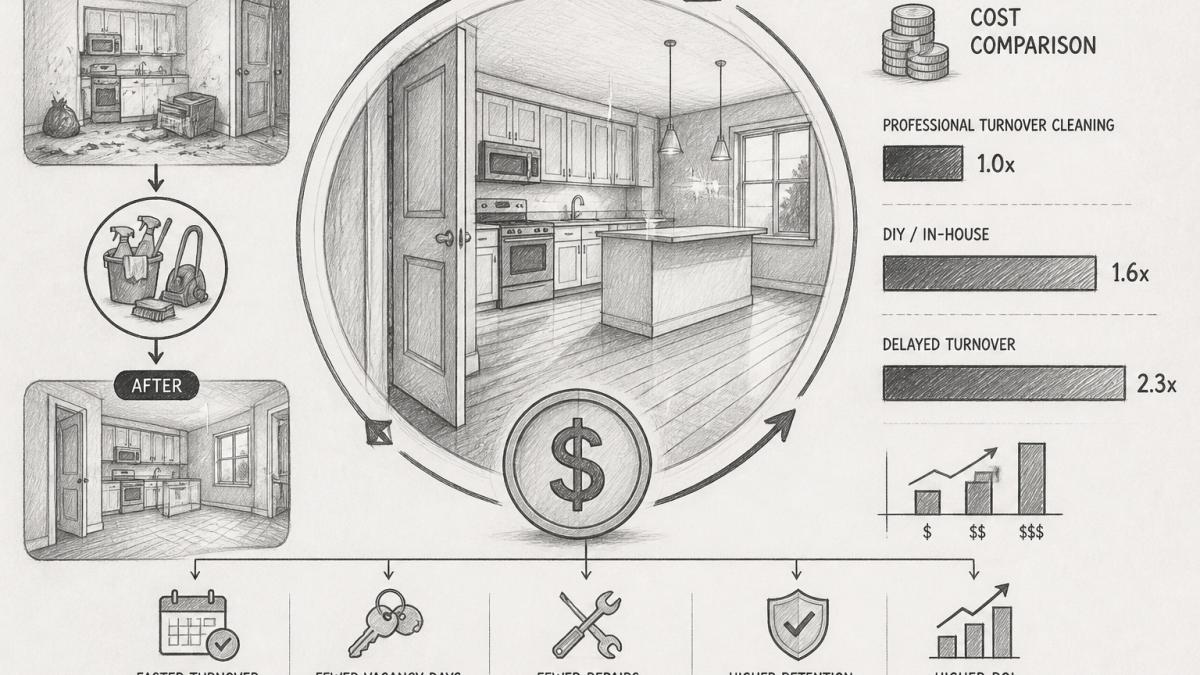
Turnover cleaning pricing varies by unit size, condition, and scope, so most providers quote per unit rather than publish flat rates. What matters more than the headline number is what is bundled into it. A low quote that excludes appliances, blinds, or post-construction dust is not a lower cost; it is a deferred cost that reappears as a callback or a delayed move-in.
Breaking Down the Line Items
A complete turnover clean typically covers:
- Kitchen and appliance interiors: oven, refrigerator, microwave, and cabinet surfaces
- Bathroom deep cleaning: grout, tile, fixtures, and mildew treatment
- Flooring: vacuuming, mopping, and carpet spot treatment
- Walls and trim: scuff removal, baseboards, and switch plates
- Windows and blinds: interior glass and dusting
- Final walkthrough prep: trash removal and staging-ready finish
When you compare quotes, compare scope, not just price. A quote that skips two of these line items will cost you more once you pay someone else to finish the job.
In-House vs. Outsourced: The Hidden Costs of Managing Cleaning Staff
The most common mistake property managers make is comparing an outsourced invoice against a cleaner's hourly wage. That comparison is incomplete by design. A W-2 cleaning employee costs meaningfully more than their posted rate once you layer on the employer-side obligations that never appear on a job posting.
What the Hourly Wage Actually Includes
When you hire cleaning staff directly, the true loaded cost per hour includes:
- Employer payroll taxes: Social Security and Medicare matching under FICA, plus federal and state unemployment contributions
- Workers' compensation insurance: a required coverage in nearly every state for cleaning staff, and priced higher because cleaning is classified as a higher-risk occupation
- Overtime exposure: under the Fair Labor Standards Act, non-exempt employees must be paid time-and-a-half past 40 hours in a workweek, which is exactly what happens during a stacked turnover week
- Paid time off, sick leave, and holiday coverage: you pay for the absence and you still have to cover the unit
- Recruiting and onboarding: job postings, background checks, paid training shifts, and the productivity dip while a new hire learns your standards
- Supervision: a manager's hours spent scheduling, inspecting, and re-training, hours that come out of your operations budget, not your cleaning budget
The Turnover Problem Inside Your Own Crew
Cleaning labor has notoriously high turnover. Every departure triggers a repeat of the recruiting, onboarding, and quality-dip cycle. During that dip, missed items become callbacks, callbacks delay move-ins, and delayed move-ins become lost rent. The cost of that churn does not show up on a payroll report, it shows up as vacancy days.
What Outsourcing Actually Transfers
A professional turnover cleaning vendor absorbs the employer-side costs, the workers' compensation exposure, the recruiting churn, and the scheduling overhead. In exchange, you get a predictable per-unit contract price and a documented scope. The trade-off is real: you give up some day-to-day control over who is in the unit, and you are dependent on the vendor's reliability. That is why vendor selection matters more than the headline rate, a cheap vendor who misses a turnover window costs more than a premium vendor who never does.
A Practical Comparison Framework
Rather than comparing an invoice to a wage, build a loaded-cost model for one unit:
- Estimate hours required for a standard turnover
- Multiply by the fully loaded hourly rate (wage + taxes + insurance + PTO allocation)
- Add a prorated share of recruiting, onboarding, and supervision
- Add the cost of one callback or one missed showing window
- Compare that total to your vendor's per-unit quote
How to Reduce Vacancy Time Between Tenants with Professional Cleaning
Learning how to reduce vacancy time between tenants comes down to one principle: the cleaning crew must be scheduled before the unit is even empty. Professional providers work from standardized cleaning protocols, which means no discovery phase, no guessing about scope, and no second visit for missed items.
Quantifying the Cost of Downtime
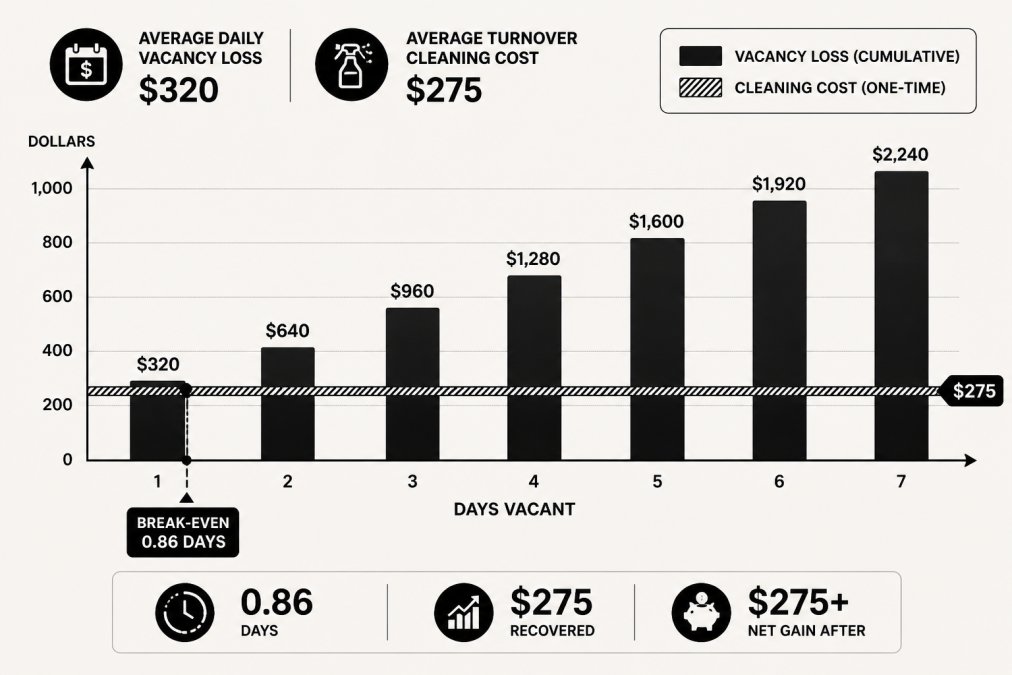
Most turnover conversations focus on the cleaning invoice. The larger number is the rent you do not collect while the unit is not showable. To make that concrete, run a simple calculation for your own portfolio:
Daily rent loss = monthly rent ÷ 30
Request Walk Thru Estimate Today →
Why Speed Compounds Across a Portfolio
A single delayed turnover is annoying. A pattern of delayed turnovers is a revenue problem. If a manager oversees 40 units with two turnovers per year each, that is 80 turnovers annually. Shaving two days off each one recovers 160 rent-days per year. At $60 per day, that is real money, and it comes back every year, not once.
The Mechanisms That Actually Compress the Gap
Speed does not come from rushing the crew. It comes from removing the friction points that cause delays:
- Pre-scheduled crews: book the turnover clean the moment the move-out notice is issued, not after the unit is empty
- Locked scope in writing: a written checklist agreed before cleaning day eliminates the most common cause of a missed showing window
- Single-visit completion: a crew that arrives with the right equipment and supplies finishes in one trip instead of returning for missed items
- Post-clean walkthrough before showings: catch issues while the crew is still on site rather than discovering them with a prospect in the doorway
- Turnaround tracking per unit: log days from move-out to show-ready and identify which units or which vendors consistently slip
The Trade-Off Nobody Mentions
Faster is not automatically cheaper if it means cutting scope. A crew that skips appliance interiors to save an hour will trigger a callback, and a callback costs more than the hour it saved. The goal is not the shortest clean, it is the shortest complete clean, done right the first time so the unit goes from move-out to show-ready without a second visit.
Your Apartment Turnover Checklist: Standardizing for Savings
A written apartment turnover checklist is what turns cleaning from a variable cost into a predictable one. Standardized cleaning protocols mean every unit is cleaned to the same spec, which reduces callbacks, protects flooring and upholstery, and makes quality assurance measurable.
| Phase | Key Tasks | Owner |
|---|---|---|
| Pre-clean | Confirm scope, schedule crew, note damage | Property manager |
| Deep clean | Appliances, grout, flooring, walls, windows | Cleaning vendor |
| Quality check | Walkthrough against checklist, log issues | Property manager |
| Ready | Final touch-ups, stage for showings | Vendor + manager |
Two Angles Competitors Miss: Tax Deductions and Insurance Premiums
Two financial levers rarely get mentioned in cleaning conversations, and both matter to your bottom line. The first is tax treatment. Ordinary and necessary business expenses, including professional cleaning services for rental property, are generally deductible, and the IRS guidance on business expenses explains which costs qualify. Confirm specifics with your accountant, but the principle is that cleaning is a deductible operating cost, not a sunk one.
Conclusion: Treating Turnover Cleaning as a Capital Investment
The managers who win on turnover speed are not the ones who found the cheapest cleaner. They are the ones who treat turnover cleaning as an investment that protects rent, assets, and reputation. Squeaky Clean Plus builds that reliability into every job with dedicated project coordination, specialization in apartment turnovers and post-construction cleaning, and a focus on the critical handoff process that keeps your projects on track.
Frequently Asked Questions
How does professional turnover cleaning reduce vacancy periods?
Professional turnover cleaning reduces vacancy periods by cutting the time a unit sits empty between tenants. Crews arrive on a coordinated schedule, complete deep cleaning and final prep in one pass, and hand off a move-in ready unit. That speed directly reduces the number of days you lose rent. For property managers with a 48-hour window between move-outs and showings, a reliable turnover cleaning partner is the difference between a unit that shows on time and one that sits idle.
What is the average cost of apartment turnover cleaning?
The average cost of apartment turnover cleaning depends on unit size, condition, and whether deep cleaning or post-construction debris removal is needed. Pricing also varies by market and service scope. Rather than quoting a flat rate, professional providers assess each unit and build a per-turnover or contract price. To get an accurate figure for your properties, request a quote from a provider that specializes in apartment turnovers and can handle your volume consistently.
What should be on an apartment turnover checklist?
A solid apartment turnover checklist covers every touchpoint a new tenant will inspect: appliance interiors and exteriors, cabinet interiors, bathroom fixtures and grout, flooring and baseboards, window tracks and blinds, light fixtures, and walls for scuffs or marks. It should also include a final walkthrough step and a quality assurance sign-off. Standardized cleaning protocols on the checklist keep results consistent across units, which reduces complaints and rework.
Is professional turnover cleaning tax deductible for property managers?
In most cases, professional turnover cleaning is a deductible business expense for rental property owners and property management companies. The IRS treats ordinary and necessary expenses for maintaining a rental property, including cleaning between tenants, as deductible operating costs. Because this reduces your taxable income, the effective cost of professional cleaning is lower than the invoice amount. Consult your tax advisor to confirm how this applies to your specific situation.
If slow turnovers and unreliable cleaning crews are costing you rent you cannot recover, it is time to change the math. Squeaky Clean Plus brings dedicated project coordination, turnover and post-construction specialization, and a handoff process built to keep your schedule intact. Get started with Squeaky Clean Plus and start an estimate to see how fast your units can be ready.