 listicle
Cleaning Services for Property Managers: 2026 Guide
Table of Contents
- Cleaning Services for Property Managers: What to Compare in 2026
- Quick Comparison: Cleaning Providers for Managed Properties
- Apartment Turnover Cleaning: Hitting the 48-Hour Window
- Move-In Cleaning Checklist: What Tenants Notice First
- Post-Construction Cleaning for Apartments: Fine Dust and Debris
- Vacant Property Cleaning: Showings, Safety, and Curb Appeal
- Pricing, Scheduling, and Quality Standards for Cleaning Services
- Conclusion: Choosing the Right Cleaning Partner
- Frequently Asked Questions
Last Updated: October 12, 2026
Cleaning Services for Property Managers: What to Compare in 2026
Cleaning services for property managers are the scheduled and on-demand cleaning programs that keep rental units, common areas, and commercial spaces tenant-ready between occupancies. At Squeaky Clean Plus, we handle turnover and post-construction cleaning for apartment communities and vacant homes, so we know the difference between a vendor who shows up and one who actually hits your deadlines. The gap between those two is where rent gets lost. This guide breaks down what to compare in 2026, from turnover speed to pricing structure, so you can pick a partner who keeps projects on track.
Most property managers evaluate cleaning vendors on price alone. That is the mistake we see most often. A cheaper per-unit rate means nothing if the crew misses your 48-hour window and the unit sits vacant an extra week.
Below, we break down each service type, what it should include, and how to compare providers without getting burned.
Quick Comparison: Cleaning Providers for Managed Properties
Four provider types dominate the market, and each fits a different need. The table below compares them on service scope, pricing model, and whether they target property managers directly.
| Provider | Service Focus | Pricing Model | Online Booking | Built for Property Managers |
|---|---|---|---|---|
| Squeaky Clean Plus | Turnover and post-construction | Project-based quote | Yes | Yes, supplier partner with AAMD |
| MaidServe | Turnover cleaning | Hourly, two-person team | Yes, instant quotes | Yes, targets local managers |
| Picture Perfect Cleaning | Residential and commercial | Contact for pricing | Contact only | Partial |
| CleanNet USA | Commercial and office | Contact for pricing | Contact only | Partial |
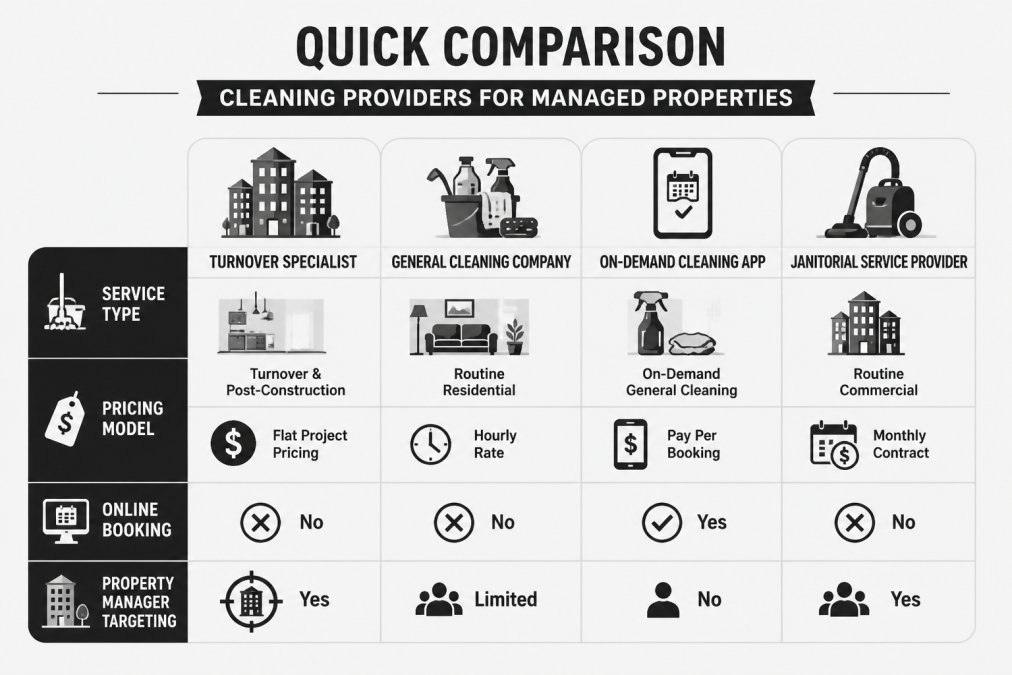
The pattern is clear: providers built specifically for property managers offer faster quoting and clearer scope. General cleaning companies can work, but you often become the project coordinator yourself.
Apartment Turnover Cleaning: Hitting the 48-Hour Window
Apartment turnover cleaning is the deep clean between one tenant moving out and the next moving in, and speed is the entire point. A 48-hour window is standard for most communities, and missing it costs real money in lost rent and delayed showings.
The work is not just wiping counters. A proper turnover covers:
- Appliance interiors, including oven and refrigerator
- Inside cabinets and drawers
- Bathroom fixtures, grout, and mildew treatment
- Flooring, baseboards, and light fixtures
- Window tracks and blinds
What most guides miss is the coordination side. Turnover cleaning only works when it is sequenced with painting, repairs, and carpet cleaning. If your cleaner arrives before the painter finishes, you pay twice.
According to the National Apartment Association's operational guidance, turnover efficiency depends on scheduling all trades in the correct order rather than running them in parallel.
That is where dedicated project coordination matters. We build the cleaning step into your turnover calendar so it lands after every other trade is done.
Move-In Cleaning Checklist: What Tenants Notice First
The move-in cleaning checklist is the final quality gate before a tenant walks through the door. First impressions drive renewal decisions, and tenants notice specific things: bathroom grout, kitchen grease, and dusty blinds top the list.
Here is the checklist we use for tenant-ready units:
Request Walk Thru Estimate Today →
- Oven interior free of grease and residue
- Refrigerator interior wiped, no odors
- Bathroom grout scrubbed, no mildew
- Toilet base and behind-bowl cleaned
- Window tracks and blinds dust-free
- Baseboards and door frames wiped
- Light fixtures and switch plates cleaned
- Floors swept, mopped, or vacuumed
A common mistake is treating move-in cleaning as a lighter version of turnover cleaning. It is not. Prospective tenants open cabinets, run their hands along shelves, and check the corners you hoped nobody would notice.
Post-Construction Cleaning for Apartments: Fine Dust and Debris
Post-construction cleaning for apartments is a different job from routine turnover work, and most cleaning crews are not equipped for it. Construction leaves fine drywall dust that settles into every surface, plus debris, adhesive residue, and paint splatter.
Standard vacuums push that dust back into the air. You need HEPA filtration and a crew trained to work top-down so dust does not resettle on finished surfaces.
The sequence matters:
- Bulk debris and material removal
- Rough dust removal from ceilings and walls
- Detail cleaning of fixtures, outlets, and trim
- Final floor cleaning and polishing
- Inspection pass under proper lighting
Vacant Property Cleaning: Showings, Safety, and Curb Appeal
Vacant property cleaning keeps empty listings presentable for showings and protects the asset while it sits empty. Dust, cobwebs, and stale odors build up fast in unoccupied units, and buyers and renters read that neglect immediately. The scope also shifts by property type, which is where most generic service lists fall short.
| Property Type | Priority Cleaning Needs |
|---|---|
| Multifamily unit | Turnover deep clean, appliance interiors, flooring, odor treatment |
| Single-family rental | Interior detail plus exterior pressure washing and yard debris |
| Office suite | Common areas, restrooms, glass, and high-touch disinfection |
| Retail space | Entry glass, floors, restrooms, and trash removal |
| Vacant lot or garage | Bulk trash removal, weed control, and surface sweeping |
For real estate agents and investment owners, the priorities differ from occupied units:
- Exterior pressure washing for siding, walkways, and driveways
- Interior dusting and airing before every showing block
- Bulk trash removal from yards and garages
- Regular check-ins to catch leaks or pest issues early
Safety and security while the unit sits empty
An empty property is a security risk as much as a cleaning job. A recurring visit gives you eyes on the asset. Build these into the scope:
- Confirm all doors and windows are locked and report any forced entry
- Check for water intrusion under sinks, around water heaters, and at exterior doors
- Look for pest activity, mold, or standing water
- Photograph the unit condition each visit and send a short report
- Verify exterior lighting and remove flyers or debris that signal vacancy
Cadence and curb appeal
Curb appeal is not cosmetic. A property that looks maintained signals a well-run asset, and that affects both showing traffic and offers. A workable cadence for most vacant listings is a full clean before the first showing, a light touch-up every one to two weeks, and a deep clean again if the listing sits past 30 days or after any contractor work. Exterior surfaces should be pressure washed before listing and re-checked after storms or landscaping work.
Pricing, Scheduling, and Quality Standards for Cleaning Services
Pricing for cleaning services depends on unit size, condition, scope, and turnaround speed, so flat per-unit quotes rarely hold up. Ask every provider to break down what drives their number before you compare totals, a low bid that excludes appliance interiors or carpet work is not a lower price, it is a smaller scope.
The factors that move price most:
| Factor | Why It Changes the Quote |
|---|---|
| Unit size and layout | More square footage and bathrooms mean more labor hours |
| Condition at move-out | Heavy soil, pet damage, or smoke residue adds time and product |
| Turnaround speed | Rush windows compress the schedule and cost more than planned work |
| Frequency and volume | Recurring monthly volume usually lowers the per-unit rate |
| Add-ons | Pressure washing, disinfection, and bulk trash removal are separate line items |
| Access method | Lockbox, keyed entry, or on-site staff escort changes labor time |
A practical way to compare bids is to request a line-item quote with four columns: labor hours, supplies, equipment, and add-ons. Two vendors quoting the same unit at different totals usually differ on labor hours, not on rate. When a quote is dramatically lower, ask which line item was cut.
Scheduling and access coordination
Scheduling is where most vendor relationships break down. Confirm four things in writing before the first job:
Request Walk Thru Estimate Today →
- Booking lead time, how many days ahead a unit must be released to the crew
- Access method, who holds keys or codes, how they are logged, and how they are returned
- Occupied-unit protocol, how the crew handles pets, personal belongings, and notice to residents
- Not-ready procedure, what happens, and what it costs, when a unit is not cleared on arrival
For occupied units, a common pattern is to give residents written notice of the visit window, require pets to be secured, and have the crew photograph the unit condition before and after. That record protects both sides if a damage claim comes up later.
Quality standards you can measure
Quality standards need to be measurable, not vague. A service-level agreement should state the inspection method, the correction window, and the remedy when a unit fails inspection. Useful terms to define:
- Inspection method, who inspects, under what lighting, against which written checklist
- Pass/fail threshold, the specific items that trigger a re-clean
- Correction window, how fast the vendor must return, and at whose cost
- Reporting, a completion report per unit with photos and any noted damage
- KPIs, on-time completion rate, first-pass inspection rate, and callback rate tracked monthly
The strongest vendor agreements define quality as a pass or fail against a written checklist, with a set window to fix failures. Verbal promises do not hold up when a unit fails inspection on move-in day.
Vendor selection checklist
Before signing, verify insurance (general liability and workers' compensation), background checks on crew members, whether staff are employees or subcontractors, and the contract's termination and price-escalation terms. A vendor who cannot produce a certificate of insurance on request is a liability you are accepting on the property owner's behalf.
Conclusion: Choosing the Right Cleaning Partner
The hardest part of managing cleaning vendors is not finding one. It is finding one that hits your turnover window every single time, coordinates with your other trades, and stands behind the work when something slips.
That is exactly what we built Squeaky Clean Plus to do. We bring dedicated project coordination to every job, specialize in apartment turnovers and post-construction cleaning, and operate as a supplier partner with the Apartment Association of Metro Denver. Our focus stays on the handoff, so every unit is ready for the next tenant without your team chasing it.
Start an estimate with Squeaky Clean Plus and keep your projects on schedule.
Frequently Asked Questions
What cleaning services do property managers need most?
Turnover cleaning between tenants, post-construction cleaning after renovations, and recurring common-area maintenance top the list. Apartment communities also need move-in cleaning, vacant property cleaning, and pressure washing for exteriors. The right mix depends on your portfolio: multifamily properties lean on turnover and common-area schedules, while single-family rentals need deep cleaning and make-ready work before showings.
How long does apartment turnover cleaning take?
A standard one-bedroom unit takes 2 to 4 hours for a crew of two. Larger units or units needing deep cleaning can take 6 to 8 hours. If you have a 48-hour window between move-out and showings, confirm the provider's crew size and whether they handle multiple units in a single visit. Scheduling and access coordination matter as much as cleaning speed.
What should a move-in cleaning checklist include?
A solid checklist covers kitchen appliances inside and out, cabinet interiors, bathroom fixtures and grout, floors, baseboards, windows, light fixtures, and closet shelves. For post-construction units, add fine dust removal from vents, outlets, and window tracks. Document the checklist with photos so you have a quality baseline and can address issues before the tenant walkthrough.
How do property managers evaluate cleaning vendors?
Start with a service-level agreement that defines scope, response times, and quality standards. Ask about insurance, crew training, and how they handle complaints. Request references from similar properties. For post-construction work, verify they have HEPA equipment for fine particles. A trial run on a few units before signing a recurring contract reduces risk and shows how the vendor performs under deadline pressure.