 ultimate-guide
Apartment Turnover Cleaning 2026 Guide for Property Managers
Table of Contents
- Apartment Turnover Cleaning Checklist: Room-by-Room Tasks
- Apartment Move-Out Cleaning Checklist: What to Do Before the Unit Is Empty
- Apartment Turnover Cleaning Time: How Long Each Unit Really Takes
- Apartment Cleaning Inspection Checklist: Quality Control Before Handoff
- 2026 Standards and Scheduling Benchmarks for Faster Turnovers
- Cleaning Products, Equipment, and Safety for Turnover Crews
- Conclusion
- Frequently Asked Questions
Last Updated: October 12, 2026
Apartment Turnover Cleaning Checklist: Room-by-Room Tasks
Apartment turnover cleaning is the process of restoring a vacant rental unit to move-in ready condition between one tenant leaving and the next arriving, and it lives or dies on a room-by-room checklist.
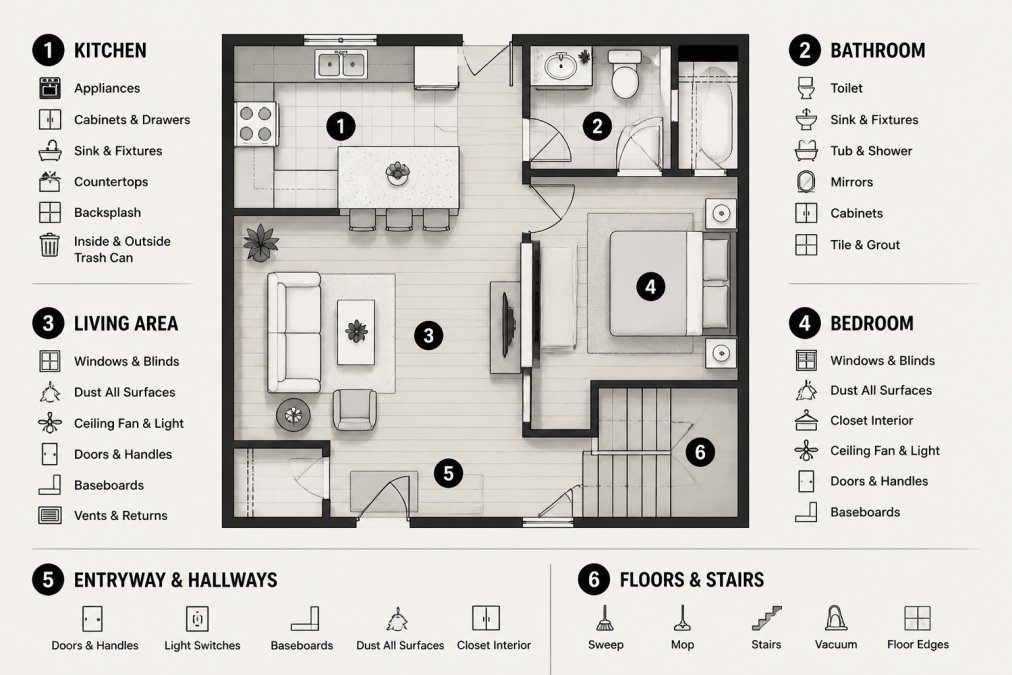
Kitchen and appliance interiors
Kitchen cleaning is where turnover crews lose the most time, because appliance interiors cannot be wiped, they have to be degreased. Pull the refrigerator shelves and drawers out, clear the sink drains, and run the dishwasher empty on a hot cycle before inspecting the filter. Grease on the range hood and cabinet fronts above the stove shows up in photos, so treat it as a priority.
Bathroom fixtures and sanitizing
Bathroom sanitizing means treating every fixture as a high-touch surface. Scrub the toilet base and floor bolts, descale the showerhead, clear the drain, and wipe the vanity, mirror, and light switch. Mildew in the caulk line is the most common reason a unit fails inspection; if the caulk is discolored, it needs replacing, not cleaning.
Living areas, bedrooms, and high-touch surfaces
High-touch surfaces decide how a unit feels the moment a prospect walks in. Switch plates, door handles, light pulls, thermostat housings, and closet rods all get wiped, even when they look clean. In living areas and bedrooms, dust baseboards, window sills, blinds, ceiling fan blades, and door frame tops, and spot-treat walls and corners. Don't forget the entryway, hallways, and stairs, the first surfaces a prospect touches.
Floors, carpets, and trash removal
Floor cleaning comes last because everything above it drops. Vacuum carpet edges and corners first, where pet hair and debris collect. Rugs get vacuumed on both sides, hard floors get mopped after vacuuming, and carpet cleaning is a separate step when the unit has stains or odor. Trash removal closes the job: every bag, closet, and balcony, plus any debris left behind.
Apartment Move-Out Cleaning Checklist: What to Do Before the Unit Is Empty
The apartment move-out cleaning checklist protects the security deposit and the schedule at the same time, and it starts before the unit is empty. Schedule the pre-move-out inspection while the departing tenant's belongings are still in place, so damage and repairs are documented against a furnished baseline.
Once the unit is vacant, work the apartment move-out cleaning checklist in this order:
- Confirm the pre-move-out inspection report and photos are filed
- Walk the unit and log damage, missing fixtures, and abandoned property
- Schedule maintenance repairs before cleaning, not after
The sequencing matters more than the speed. Cleaning a unit before maintenance repairs means cleaning it twice.
Apartment Turnover Cleaning Time: How Long Each Unit Really Takes
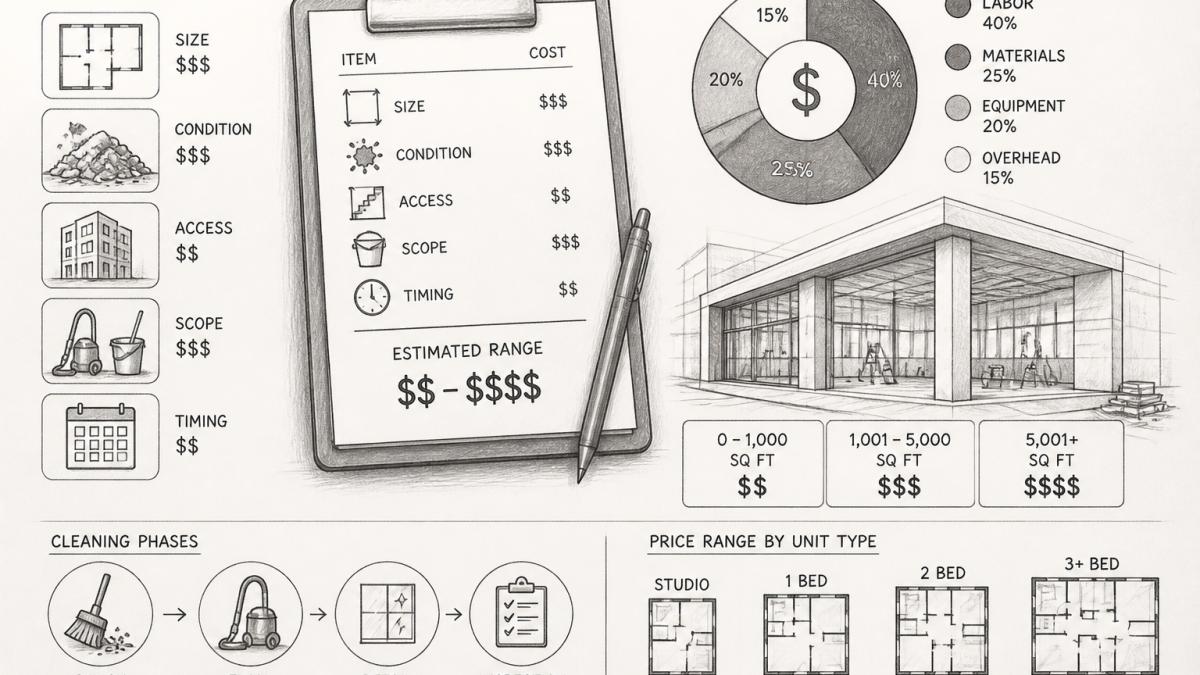
Apartment turnover cleaning time is usually quoted as a single number, which is why so many vacancy windows slip. Cleaning time is a function of three variables: square footage, soil level, and crew size.
| Unit Size | Light Soil | Standard Soil | Heavy Soil or Pet Odor |
|---|---|---|---|
| Studio / efficiency | 1.5-2.5 crew hours | 2.5-4 crew hours | 4-6 crew hours |
| 1 bedroom / 1 bath | 2-3 crew hours | 3-5 crew hours | 5-8 crew hours |
| 2 bedroom / 1-2 bath | 3-4 crew hours | 4-7 crew hours | 7-11 crew hours |
| 3 bedroom / 2 bath | 4-6 crew hours | 6-9 crew hours | 9-14 crew hours |
"Crew hours" is the number that matters, not clock hours. Two cleaners working a 2-bedroom for four crew hours finish in two clock hours; a single cleaner takes four.
What actually drives the number up
- Appliance interiors. A refrigerator with caked-on residue and a never-pulled dishwasher filter can add 45-90 minutes.
- Oven and range hood degreasing. Heavy baked-on grease is the most common add-on. Budget an extra 30-60 minutes when the oven has not been cleaned in over a year.
- Post-construction dust. Fine drywall dust settles after the first wipe-down. Plan a second pass 24 hours later.
Building the vacancy window backward
The turnover window is the number of days between move-out and move-in ready, and it should be set by the slowest step, not the cleaning crew. Build it backward from the move-in date:
Request Walk Thru Estimate Today →
- Move-in date minus 1 day, final walkthrough and photo documentation.
- Minus 1 day, touch-up pass for anything the walkthrough flagged.
- Minus 1-2 days, carpet cleaning and dry time.
- Minus 1 day, full turnover clean.
- Minus 1-3 days, maintenance and repairs, scheduled in parallel where possible.
- Move-out day, pre-move-out inspection while the unit is still furnished.
That sequence gives a realistic 5-8 day window for a standard unit and 10-14 days for heavy-soil or post-construction jobs. To hit a 3-day turnaround, overlap maintenance and cleaning and have the crew on standby before the unit is confirmed empty.
Crew lead time and confirmation
Crew lead time is how far ahead a vendor needs the unit confirmed before they can staff it. For a single unit, most vendors want 48-72 hours; for a multi-unit turnover at the same property, two weeks is safer, since crews must be sequenced across units. Confirm the morning of and expect a premium rate or a declined job.
Convert every quote to crew hours, build the vacancy window backward from the move-in date, and confirm the unit 48-72 hours ahead. Those three habits do more for on-time turnovers than any single cleaning product.
Apartment Cleaning Inspection Checklist: Quality Control Before Handoff
An apartment cleaning inspection checklist turns a subjective "looks clean" into a pass or fail, so the handoff does not depend on who walked the unit.
Run the inspection with the lights on and blinds open; dust and streaks hide in low light. Photograph every room after the inspection passes, and file the images with the unit number and date.
Inspect from the doorway first, then from inside the room. The doorway view is what a prospect sees in the listing photo, and it catches missed baseboards and uneven floor finish that a close-up walk-through will not.
2026 Standards and Scheduling Benchmarks for Faster Turnovers
Most turnover guides treat "2026 standards" as a marketing phrase. In practice, the standards that matter fall into three buckets: what the lease and local code require, what the owner or management company requires, and what the incoming tenant will inspect. The first creates legal exposure, and it is the one most checklists skip.
Cleaning versus damage: the line that decides a deposit
A security deposit deduction has to be tied to actual damage or a lease violation, not ordinary wear and tear. Cleaning restores a unit to its move-in condition, minus normal wear; damage is a repair or replacement.
A practical rule: if an item can be restored to move-in condition with cleaning, it is a cleaning cost; if not, it is a repair or replacement cost.
How to verify the rules that apply to your unit
There is no single national turnover standard. Requirements come from a mix of sources, so check them directly:
- The lease agreement. It defines the move-out condition the tenant agreed to, including any required professional cleaning. Read it before quoting a job.
- State and local landlord-tenant law. Deposit return deadlines, itemization, and notice rules vary by state and city. Your state attorney general's office and local housing authority publish plain-language summaries.
- Local health and housing codes. These govern habitability, not cleanliness: smoke and carbon monoxide alarms, ventilation, pest-free conditions. A turnover clean does not satisfy a code violation; a repair does.
Before your first turnover at a new property, ask the manager for three things: the lease's move-out condition clause, the management company's turnover checklist, and the deposit itemization template. Those three documents tell you exactly what "clean enough" means for that property.
Scheduling benchmarks that hold up
Two benchmarks separate teams that hit their vacancy targets from teams that miss them. The first is the turnover window, days between move-out and move-in ready, set by the slowest step, usually carpet cleaning or a repair, not the cleaning crew. The second is crew lead time: most vendors want 48-72 hours for a single unit and about two weeks for a multi-unit turnover.
Request Walk Thru Estimate Today →
Documentation that makes the standard enforceable
Documentation is the other 2026 standard worth adopting. Dated photos, a signed inspection checklist, and a written handoff note give a property manager something to show an owner, a regional supervisor, or a prospective tenant later, and make vendor performance measurable.
A workable documentation package includes:
- A timestamped photo set of every room, taken after the final walkthrough passes.
- A signed inspection checklist keyed to the room-by-room tasks the crew worked from.
- A written handoff note listing any item that was flagged and left for maintenance.
The fastest turnovers come from parallel scheduling, not faster cleaning. Book maintenance and cleaning into overlapping windows, hold the unit to a documented inspection standard, and keep cleaning costs and damage costs on separate lines before the unit goes back on the market.
Cleaning Products, Equipment, and Safety for Turnover Crews
Cleaning products and equipment for turnover work should be chosen for the job, not the shelf. Degreasers for kitchen surfaces, a non-abrasive bathroom cleaner, and a separate disinfectant for high-touch surfaces cover most of the work.
Safety is the part crews skip when the schedule is tight. Ventilate when using any chemical product, never mix bleach with an ammonia-based cleaner, wear gloves and eye protection with degreasers, and follow the manufacturer's dwell time on disinfectants.
Conclusion
The hard part of turnover work is not the cleaning itself, it is coordinating repairs, carpet cleaning, inspection, and handoff inside a vacancy window that never feels long enough. When a unit needs more than cleaning, patched drywall, a replaced fixture, a repair that has to happen before the crew can start, Remodeling & Handyman Services can cover that side of the job.
Frequently Asked Questions
What is included in apartment turnover cleaning?
Apartment turnover cleaning covers everything needed to make a unit move-in ready for the next tenant. That includes dusting surfaces, baseboards, and switch plates; wiping walls and corners; cleaning kitchen appliances inside and out (refrigerator shelves, sink drains, dishwasher); sanitizing bathroom fixtures; vacuuming and carpet cleaning, including carpet edges; mopping floors; and removing all trash. Many property managers also add entryway, hallway, and stair rail cleaning to the checklist so common paths match the unit's condition.
How long does apartment turnover cleaning take?
Turnaround time depends on unit size, condition, and whether it is a standard clean or a deep clean after a long tenancy. Turnaround time varies significantly based on unit size, condition, and whether it is a standard clean or a deep clean after a long tenancy. Post-construction or renovation dust adds significant time because fine particles settle on every surface. Scheduling crews in blocks and using a room-by-room checklist helps keep apartment turnover cleaning time predictable and reduces vacancy days.
What is the difference between move-out cleaning and turnover cleaning?
Move-out cleaning is what a departing tenant does to avoid deductions from their security deposit. Turnover cleaning is the deeper, professional service a property manager arranges between tenants. Turnover cleaning goes further: it addresses damage inspection findings, maintenance repairs, and the final walkthrough, and it prepares the rental unit for showings. The apartment move-out cleaning checklist focuses on the tenant's responsibility, while turnover cleaning ensures the unit meets the landlord's standard for the next tenant.
Should carpets be cleaned before or after apartment turnover cleaning?
Carpets should be cleaned after all dusting, wiping, and trash removal are complete. If you clean carpets first, later dusting and vacuuming will drop debris back onto the fresh carpet. Schedule carpet cleaning as the final step before the quality check. For units with area rugs, vacuum both sides and let them dry fully before placing them back. This order keeps carpet edges and rugs looking clean at the final walkthrough and prevents rework.
How do you inspect an apartment after turnover cleaning?
Use a written apartment cleaning inspection checklist that mirrors the room-by-room tasks. Walk the unit after the crew finishes and check high-touch surfaces, baseboards, corners, kitchen appliances, bathroom fixtures, and floors under raking light. Note any missed spots on a quality check form and photograph them for the vendor. A documented handoff with sign-off protects both the property manager and the cleaning service, and it creates a record if the next tenant raises concerns.