 ultimate-guide
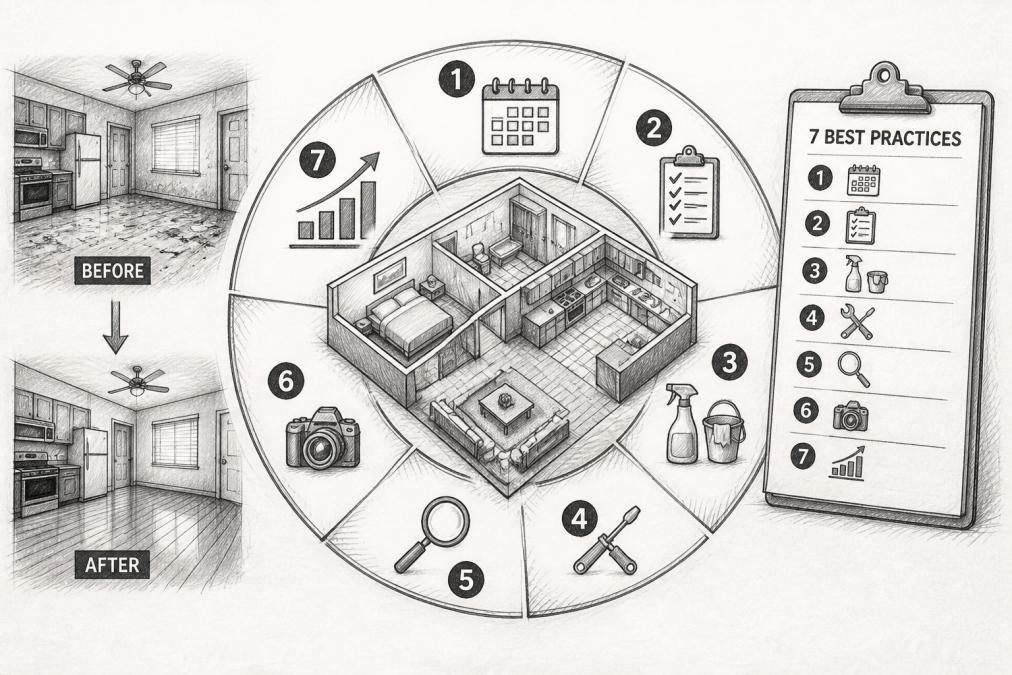
Apartment Turnover Coordination: 7 Best Practices
Table of Contents
- What Apartment Turnover Coordination Actually Involves
- Average Apartment Turnover Time and the Cost of Vacancy Loss
- The Apartment Turnover Checklist for Property Managers
- How to Automate Apartment Unit Turnover Scheduling
- Vendor Coordination and Trade Scheduling During a Turn
- DIY vs. Outsourced Turnover: A Cost-Benefit Breakdown
- Legal Compliance and Post-Turnover Quality Assurance
- Frequently Asked Questions
Last Updated: September 23, 2026
What Apartment Turnover Coordination Actually Involves
Apartment turnover coordination is the operational process of moving a unit from one resident's move-out to the next resident's move-in, covering inspections, work orders, vendor scheduling, and final quality checks. This guide from Squeaky Clean Plus breaks down the seven practices that keep that sequence on track.
At its core, turnover coordination is a handoff problem. A move-out notice starts a clock. Every task after that, from the move-out inspection to the final cleaning, either shortens or lengthens the vacancy window. Property managers who treat each task as a separate errand lose days. Those who run turnover as one coordinated project protect their rent roll.
The difference shows up in operational efficiency, not effort. A well-run turnover cycle depends on standardized procedures, clear ownership at each stage, and vendors who hit their scheduled windows. Below, we'll show you exactly how the best-run properties structure that sequence, and where most teams lose time.
Average Apartment Turnover Time and the Cost of Vacancy Loss
The average apartment turnover time ranges from about one to three weeks for a standard unit, depending on unit condition, trade availability, and how quickly inspections and work orders move. Every day inside that window is vacancy loss: rent you are not collecting while the unit sits empty.
Vacancy loss compounds quietly. A unit held two extra days for a painting schedule that slipped costs the same as a unit held two extra days because nobody ordered the work order. The cause differs; the financial hit does not.
A common mistake is measuring turnover by completion date instead of by stage. Track each phase separately, notice to inspection, inspection to work orders, work orders to unit readiness, and you will find the bottleneck fast. In practice, the delay is rarely the trades. It is the gap between the inspection and the work orders that follow it.
The Apartment Turnover Checklist for Property Managers
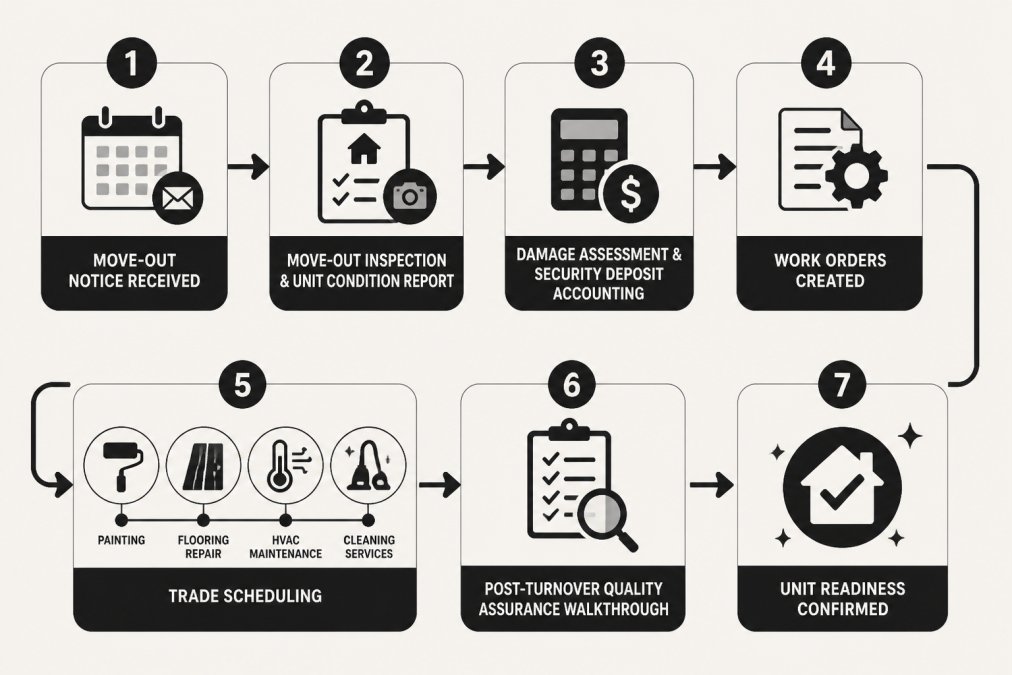
A strong apartment turnover checklist for property managers sequences every task in order and assigns an owner to each one. The sequence matters more than the list itself, because a missed step early forces rework later.
Move-Out Inspection and Damage Assessment
The move-out inspection is the anchor of the entire turnover cycle. Walk the unit with the resident's file in hand, photograph everything, and complete the unit condition report before anyone touches the space.
Damage assessment separates normal wear from chargeable damage. Document both. The security deposit is not yours to keep by default; it is held against documented findings, so the inspection record is your evidence.
Request Walk Thru Estimate Today →
Make-Ready Work Orders and Unit Condition Reports
Make-ready work orders translate inspection findings into assigned tasks. One work order per trade, each with a scope, a deadline, and a named owner, beats a single catch-all ticket that nobody can close.
The unit condition report closes the loop. It records the unit's state at move-out, then again at unit readiness. Any gap between the two is either incomplete work or new damage, and both need answers before the next lease starts.
How to Automate Apartment Unit Turnover Scheduling
Automating apartment unit turnover scheduling means connecting your move-out dates, work orders, and vendor calendars so tasks trigger themselves instead of waiting on a phone call. The goal is fewer manual handoffs, not more software.
Start with what you already run. Most property management software suites create make-ready work orders automatically from a move-out date. That single automation removes the most common delay in the turnover cycle: the day or two between inspection and ticket creation.
Next, standardize your turnover checklist inside the tool. Digital checklists force completion before a unit moves to the next stage, which is how you catch a missed HVAC maintenance task before it becomes a resident complaint.
Tools That Handle Work Orders and Vendor Coordination
Several platforms handle make-ready work orders and vendor coordination directly. Which one fits depends on portfolio size and whether you want software, a service platform, or both.
| Tool | Best For | Key Turnover Features |
|---|---|---|
| Squeaky Clean Plus | Turnover and post-construction cleaning | Dedicated project coordination, reliable scheduling for tight windows |
| Lula | Outsourcing maintenance coordination | Automated work order dispatching, real-time status tracking |
| Lessen | Large multifamily portfolios | Centralized dashboard, standardized quality control checklists |
| ResMan | Full property operations | Integrated make-ready work orders, vacancy cost reporting |
| OxMaint | Maintenance-focused teams | Digital make-ready checklists, mobile field app |
| Elevate OS | Resident lifecycle management | Task assignment automation, turnover analytics |
| MRI Software | Institutional owners | Financial reporting, scalable work order management |
| Hostfully | Short-term rentals | Automated cleaning task scheduling, calendar integration |
For most apartment communities, the practical setup is a management system for work orders plus a specialized cleaning partner for the make-ready finish. Turnover Apartment Cleaning handles that second piece with dedicated project coordination on every turnover, which matters when your window between move-outs and showings is measured in hours rather than days.
Vendor Coordination and Trade Scheduling During a Turn
Vendor coordination is where turnover schedules live or die. A turnover cycle typically involves painting, flooring repair, HVAC maintenance, cleaning services, and sometimes capital improvements, and each trade wants the unit at a different stage.
DIY vs. Outsourced Turnover: A Cost-Benefit Breakdown
Most guides treat DIY versus outsourced turnover as a preference question. It is a math question, and the math changes with unit count, rent level, and how tight your leasing calendar is.
Request Walk Thru Estimate Today →
Use unit count as your first filter:
- Under roughly 20 units with staggered lease expirations: Fully DIY can work if you have slack in the maintenance schedule and residents are not waiting on a tight move-in date.
- 20 to 100 units: Hybrid is almost always the right answer. Keep repairs and punch-list work in-house, outsource the specialized stages, make-ready cleaning and post-construction cleanup, where speed and consistency matter most.
- Over 100 units or any portfolio with back-to-back turns: Fully outsourced turnover coordination pays for itself through compressed vacancy windows and predictable unit readiness dates.
| Approach | Best For | Main Trade-Off |
|---|---|---|
| Fully DIY | Under ~20 units, staggered expirations, slack maintenance capacity | Ties up technicians, slower turns, deferred maintenance risk |
| Hybrid (in-house repairs, outsourced cleaning) | 20-100 units, moderate lease clustering | Requires disciplined vendor coordination and shared scheduling |
| Fully outsourced | 100+ units, clustered expirations, high-rent units | Higher per-unit invoice, faster and more predictable unit readiness |
Legal Compliance and Post-Turnover Quality Assurance
Three compliance mechanisms carry most of the risk:
Move-out notice timing. Most jurisdictions require written notice within a defined window, and the clock usually starts on receipt, not on the date the notice is dated. Log the delivery method and date. If your notice period is short, a missed day can push the entire turnover schedule.
A structured QA pass has three parts:
- Checklist verification. Every line item initialed by the person who completed it and confirmed by the person who inspected it.
- Photo documentation. Same angles as the move-out inspection, so you have a before-and-after record for the file.
- Leasing-ready sign-off. A named person confirms the unit is ready, and that name goes in the record. Accountability without a name is a wish.
Frequently Asked Questions
What is the average apartment turnover time?
Most apartment communities target a 5 to 10 day make-ready window between move-out and the next move-in, though the actual average apartment turnover time varies by unit condition, scope of work, and vendor availability. Turns involving flooring repair, full repainting, or HVAC maintenance run longer. Tracking your own cycle time per unit type gives you a realistic baseline for scheduling and lease expiration planning.
How can property managers reduce unit vacancy time?
Start the turnover checklist before the resident moves out. Issue move-out notices early, pre-schedule vendors, and use standardized make-ready work orders so no task waits on a phone call. Automating apartment unit turnover scheduling shortens the gap between work orders and vendor dispatch. Pair that with post-turnover quality assurance so units pass inspection on the first walkthrough instead of being reworked.
What should be included in an apartment turnover checklist?
A working apartment turnover checklist for property managers covers: move-out inspection and unit condition report, damage assessment and security deposit reconciliation, key management and smart access control updates, painting schedule, flooring repair, HVAC maintenance, cleaning services, and a final unit readiness walkthrough. Assign each task an owner and a due date so nothing stalls between trades.
How do you coordinate maintenance and cleaning during a unit turn?
Sequence the trades so wet work finishes first. Painting and flooring repair happen before cleaning services, and HVAC maintenance should be completed before the final clean. Share one schedule with every vendor and confirm arrival windows the day before. A dedicated project coordinator on the cleaning side keeps the handoff between trades from becoming your job.