 ultimate-guide
Turnover Cleaning Pricing for Apartments: 2026 Guide
Table of Contents
- How Turnover Cleaning Pricing for Apartments Is Calculated
- Apartment Turnover Price Matrix by Unit Size and Condition
- Rental Turnover Cleaning Cost: What Changes the Final Number
- Apartment Cleaning Rates by Size: Studio to Three-Bedroom
- Turnover Cleaning Checklist for Apartments: Setting Scope Boundaries
- Apartment Cleaning Quote Template for Property Managers
- Frequently Asked Questions
Last Updated: October 9, 2026
How Turnover Cleaning Pricing for Apartments Is Calculated
Turnover cleaning pricing for apartments is the total charge a cleaning provider bills to return a vacant unit to move-in condition between one tenant and the next. Most consumer guides skip straight to a number, which is why quotes rarely match expectations. Below, we break down the pricing models you will see in the market and the drivers that move the final figure.
Flat-Rate, Hourly, Per-Square-Foot, and Per-Bedroom Models
Four pricing models dominate apartment cleaning quotes, and each shifts risk to a different party.
- Flat-rate pricing: One fixed number per unit. Best for property managers who need a predictable per-unit budget across a portfolio.
- Hourly rate: Billed by labor time. Works when scope is genuinely unknown, but it punishes the client when a crew is slow.
- Per-square-foot pricing: A rate multiplied by unit square footage. Simple to forecast, but it ignores condition entirely.
- Bedroom-based pricing: A set tier for studio, one-bedroom, two-bedroom, and three-bedroom layouts. Fast to quote and easy to compare across a portfolio.
A common mistake is choosing a model before defining scope. The model sets the shape of the invoice; scope sets the size. Property managers who lock scope first and model second get fewer disputes.
The Four Cost Drivers Behind Every Quote
Four variables explain nearly every difference between two quotes for the same floor plan.
- Unit condition. A light cleaning on a well-kept unit takes a fraction of the time a heavy cleaning on a neglected one requires.
- Scope of work. Standard, deep, and turnover cleans cover different surfaces and appliances.
- Unit size and layout. Square footage and bedroom count drive labor hours more than any other factor.
- Turnaround time. A 48-hour window between move-out and showings compresses scheduling and raises cost.
Apartment Turnover Price Matrix by Unit Size and Condition
Pricing scales with two axes: unit size and cleaning condition. A studio in light condition sits at the bottom of the range; a three-bedroom in heavy condition sits at the top. The matrix below gives working price bands for each combination. Treat the numbers as a budgeting baseline, not a bid, local labor rates, travel, and scope will move the final quote.
| Unit Size | Light Cleaning | Medium Cleaning | Heavy Cleaning |
|---|---|---|---|
| Studio | $120-$180 | $180-$260 | $260-$380 |
| One-bedroom | $150-$220 | $220-$320 | $320-$460 |
| Two-bedroom | $190-$280 | $280-$400 | $400-$580 |
| Three-bedroom | $240-$350 | $350-$500 | $500-$720 |
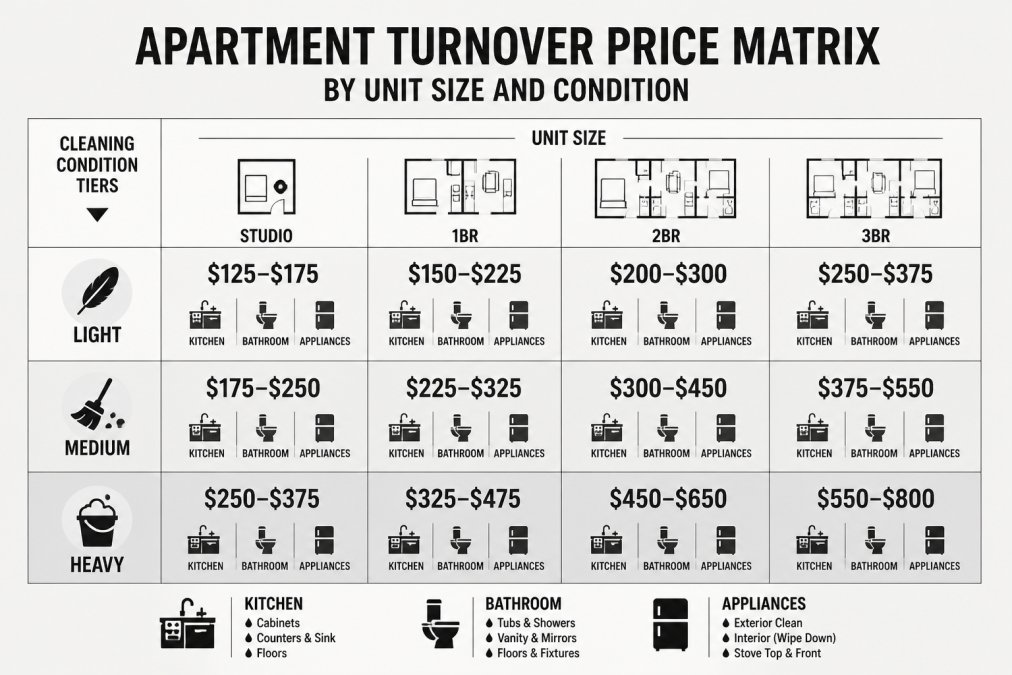
Light cleaning covers a unit left in reasonable condition: vacuuming, surface wiping, bathroom and kitchen refresh. Medium cleaning adds inside appliances, cabinet fronts, and baseboards. Heavy cleaning addresses buildup, stains, and neglected areas that require extra labor hours.
The jump from one tier to the next is rarely linear. Moving a two-bedroom from medium to heavy often costs more than moving it from light to medium, because heavy cleaning requires more crew time per square foot.
How to Read the Matrix Against a Real Quote
Use the matrix as a sanity check, then reconcile it against the provider's pricing model. A flat-rate quote that lands inside the band for the unit's condition tier is usually built on a defined scope. A quote that lands below the light-cleaning floor almost always means a narrower scope, no appliance interiors, no baseboards, no closet wipe-down, not a better rate. A quote that lands above the heavy-cleaning ceiling usually includes add-ons (carpet extraction, junk removal, post-construction dust) that should be itemized separately.
Three adjustments move a unit within the band:
- Bathroom count. Each additional full bath adds roughly 30-60 minutes of crew time, which is why a two-bedroom with two baths often quotes closer to a three-bedroom with one bath.
- Appliance interiors. Oven and refrigerator interiors are the single most common scope add-on.
- Turnaround window. A 24-48 hour turnaround between move-out and showings compresses scheduling.
Rental Turnover Cleaning Cost: What Changes the Final Number
Rental turnover cleaning cost is driven less by the headline rate than by the conditions a crew finds on arrival. Two units of identical size can land in different tiers once a walkthrough reveals the actual state of the property.
What pushes a unit into a higher tier:
Request Walk Thru Estimate Today →
- Pet hair, odor, and dander requiring extra treatment
- Grease buildup in the kitchen and on appliances
- Hard water and soap scum in bathrooms
- Carpet stains that need extraction rather than vacuuming
- Left-behind furniture or debris requiring junk removal
- Post-construction dust from a recent renovation
What keeps a unit in a lower tier:
- Tenant cleaned before move-out
- No pets and no smoking
- Recent professional cleaning on record
- Minimal personal property left behind
A walkthrough before quoting eliminates most surprises. When a property manager sends photos of the unit condition, the quote is more accurate and the crew arrives with the right supplies and time allocation.
Apartment Cleaning Rates by Size: Studio to Three-Bedroom
Apartment cleaning rates by size follow a predictable pattern: labor hours rise with square footage and bedroom count, and the bathroom count matters as much as the bedroom count. A two-bedroom with two bathrooms takes longer than a two-bedroom with one. The table below converts that pattern into crew hours and a per-unit rate range.
| Unit Type | Typical Scope | Crew Hours | Rate Range |
|---|---|---|---|
| Studio | Kitchen, bath, main living area | 2-3 hrs | $120-$200 |
| One-bedroom | Adds bedroom, closet interiors | 3-4 hrs | $150-$260 |
| Two-bedroom | Adds second bedroom, second bath | 4-6 hrs | $200-$380 |
| Three-bedroom | Adds third bedroom, larger common areas | 6-8 hrs | $300-$520 |
Square footage and bedroom count are proxies for labor, not the labor itself. A 900-square-foot two-bedroom with two bathrooms can take longer than a 1,100-square-foot two-bedroom with one bathroom, because bathroom cleaning is labor-intensive per square foot.
Where the Hours Actually Go
Crew time is not spread evenly across a unit. In a typical two-bedroom turnover, the kitchen and bathrooms consume the majority of labor, while bedrooms and living areas are comparatively fast. That distribution is why two units of identical square footage can quote differently:
- Kitchen (30-40% of labor). Counters, sink, cabinet fronts, stovetop, and appliance interiors. Grease buildup and oven interiors are the biggest time sinks.
- Bathrooms (25-35% of labor). Toilets, tubs, showers, sinks, mirrors, and fixtures. Hard water and soap scum can double the time on a single bath.
- Bedrooms and living areas (20-30% of labor). Vacuuming, mopping, baseboards, light fixtures, and blinds. Closet interiors and window sills add time but rarely dominate a quote.
- Common areas and touch-ups (5-15% of labor). Trash removal, wall spot treatment, and final walkthrough.
How Providers Build the Rate
A defensible per-unit rate is not a guess, it is labor plus supplies plus travel plus margin. Most cleaning businesses price a turnover to cover supplies, equipment wear, travel, insurance, and overhead, then add margin. When you compare vendors, ask whether the rate is built on crew hours or on a flat per-unit figure; the two models produce different numbers for the same scope and are not directly comparable.
Turnover Cleaning Checklist for Apartments: Setting Scope Boundaries
A turnover cleaning checklist for apartments defines exactly what is included and what falls outside the quote. Scope boundaries prevent disputes and keep the handoff predictable.
What a standard turnover clean includes:
- Kitchen: counters, sink, cabinet fronts, stovetop, interior of oven and refrigerator
- Bathrooms: toilets, tubs, showers, sinks, mirrors, fixtures
- Living areas: vacuuming, mopping, baseboards, light fixtures, blinds
- Bedrooms: vacuuming, closet interiors, window sills
- All rooms: trash removal, surface wiping, spot treatment on walls
What typically falls outside standard scope:
- Carpet cleaning and extraction
- Junk removal and hauling
- Exterior windows and balconies
- Post-construction fine dust removal
- Painting, repairs, and handyman work
Apartment Cleaning Quote Template for Property Managers
An apartment cleaning quote template gives property managers a consistent format for comparing vendors across a portfolio. Use the fields below when requesting or reviewing quotes.
Quote request fields:
Request Walk Thru Estimate Today →
- Property name and unit number
- Unit size: square footage, bedroom count, bathroom count
- Current unit condition: light, medium, or heavy
- Scope requested: standard, deep, or turnover clean
- Add-ons: carpet cleaning, junk removal, appliance interiors
- Turnaround window: hours between move-out and next showing
- Access details: lockbox, key, or on-site contact
Quote response fields:
- Pricing model: flat rate, hourly, per-square-foot, or per-bedroom
- Total quoted amount and what it covers
- Estimated crew size and on-site duration
- Supplies and equipment included
- Re-clean policy if inspection fails
For multifamily portfolios, ask whether the provider offers commercial-scale pricing for recurring unit volume. A single-unit quote and a portfolio rate are different products, and providers who handle both will quote them separately.
Squeaky Clean Plus coordinates Turnover Apartment Cleaning for apartment communities and vacant homes, with dedicated project coordination on every job. As a supplier partner with the Apartment Association of Metro Denver, we focus on the handoff between move-out and move-in so units are ready on schedule.
Turnover schedules slip when the cleaning vendor is the weak link. Squeaky Clean Plus handles apartment turnovers and post-construction cleaning with dedicated project coordination on every job, so units are ready for the next tenant without follow-up visits. Our team works as a supplier partner with the Apartment Association of Metro Denver, and we build every quote around unit size, condition, and scope so there are no surprises at invoice time.
Frequently Asked Questions
How much should a landlord budget for cleaning between tenants?
Budgeting depends on unit size, condition, and local labor rates. A studio in light condition sits at the low end of the range, while a three-bedroom with heavy buildup or pet damage sits at the high end. Build a per-unit reserve and adjust it after the first few turnovers, when you can see actual invoices against actual condition. For a firm number, request a quote based on your unit mix and current condition.
What factors affect apartment turnover cleaning prices?
Four factors drive most of the price: unit size in square footage and bedroom count, the condition the tenant left behind, the scope you need (standard turnover versus deep clean), and optional add-ons like carpet cleaning or junk removal. Travel distance and scheduling urgency also matter. A unit that needs only a light clean costs less than one with heavy kitchen grease, stained carpets, and abandoned furniture.
Is $50 an hour for cleaning good?
Hourly rates vary by market and by the type of clean. A turnover clean is not the same as routine housekeeping: it includes appliance interiors, inside cabinets, and often carpet work. The better comparison is total cost per unit turned, not the hourly number. Ask for a flat-rate quote so the price is fixed before the crew arrives.
Should carpet cleaning and junk removal be included in turnover cleaning?
Treat them as separate line items. Carpet cleaning depends on square footage, stain severity, and whether pet treatment is needed. Junk removal depends on volume and disposal fees. Bundling them into one flat rate hides the cost and makes it harder to compare quotes. A transparent quote lists base cleaning, carpet, and junk removal separately so you can approve or decline each one.
How can property managers compare apartment cleaning quotes?
Compare scope, not just price. Ask each vendor to quote against the same checklist and the same unit condition. A low bid often excludes appliance interiors, blinds, or carpet work, so the final invoice lands higher. Require a flat rate, a documented scope, a turnaround commitment, and a re-clean policy. That combination lets you compare vendors on total cost per unit, not headline price.
How long does it take to clean an apartment between tenants?
Turnaround time depends on unit size and condition. A light-condition studio may take a small crew a couple of hours, while a heavy three-bedroom with carpet work can take most of a day. For a 48-hour window between move-out and showings, schedule the clean immediately after the unit is cleared and confirm the crew size in advance. Ask the vendor for a written turnaround commitment, not a verbal estimate.