 ultimate-guide
Commercial Construction Cleaning Pricing Guide 2026
Table of Contents
- How Commercial Construction Cleaning Pricing Works
- Post Construction Cleaning Square Foot Pricing Explained
- Commercial Cleaning Bid Template: What Every Line Item Should Cover
- Post Construction Cleaning Checklist: Rough Clean to Final Detail
- Labor Rate Benchmarks and Complexity Multipliers
- Equipment, Supplies Overhead, and Safety Compliance Costs
- Frequently Asked Questions
Last Updated: September 30, 2026
How Commercial Construction Cleaning Pricing Works
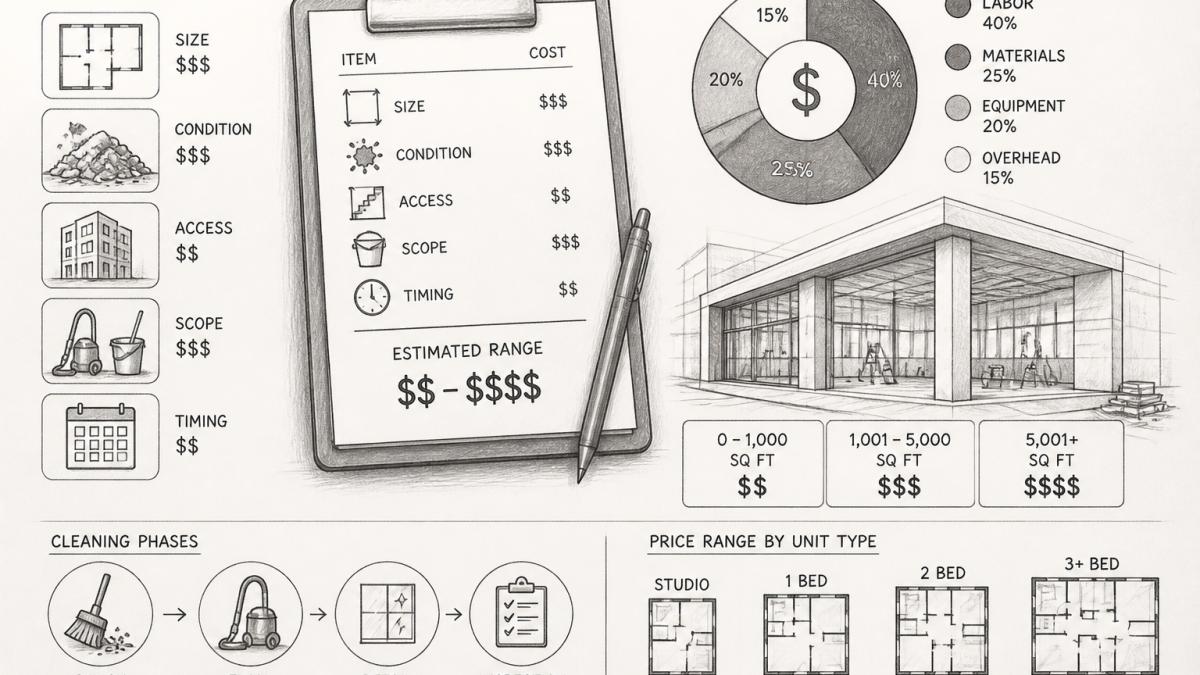
Commercial construction cleaning pricing is the process of calculating what it costs to bring a newly built or renovated commercial space to a finished, occupiable condition, based on square footage, labor intensity, project phase, and disposal needs. According to OSHA's guidance on construction site hazards, post-construction environments carry distinct dust and debris risks that shape how a crew must be staffed and equipped, which is why pricing rarely comes down to a single flat number.
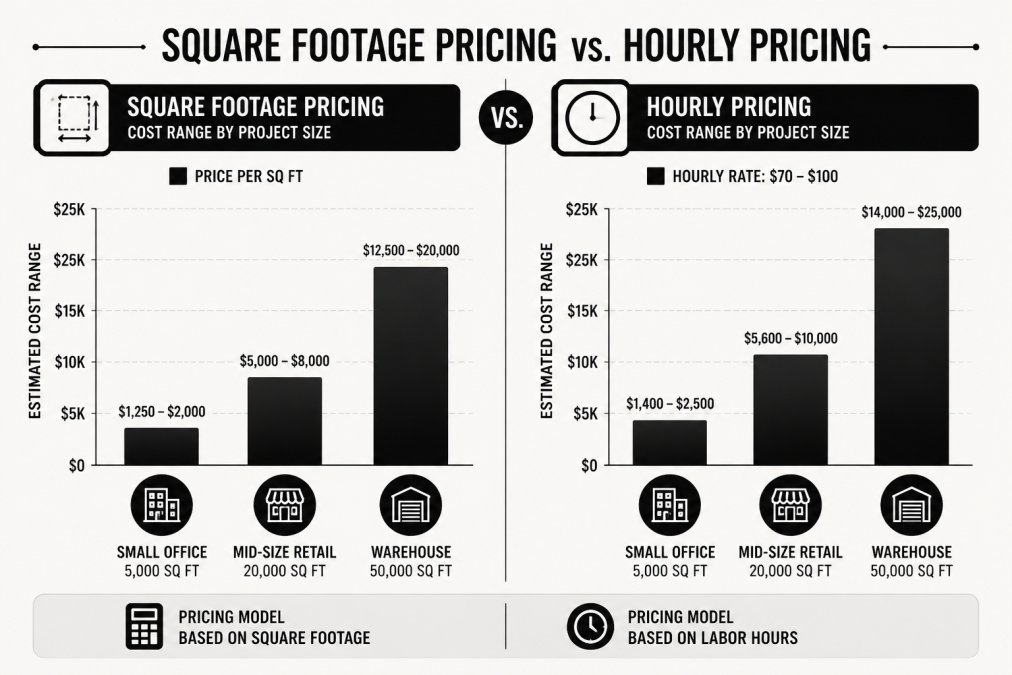
Square Footage vs. Hourly Pricing Models
Square footage pricing charges a set rate per square foot of finished floor area, giving a predictable total before work begins. Hourly pricing bills actual labor hours plus materials, protecting the contractor when a site is dirtier than expected.
The Real Cost Drivers Behind Every Quote
Four variables move a quote more than anything else: total square footage, phase count, fixture and glass density, and disposal volume. A 20,000 square foot open warehouse and a 20,000 square foot medical office do not price the same.
Post Construction Cleaning Square Foot Pricing Explained
Post construction cleaning square foot pricing multiplies a rate per square foot by the total cleanable area, then adjusts for complexity. The rate varies by region, phase, and final-clean detail.
Linear Foot Pricing for Trim, Windows, and Fixtures
Some scopes price by linear foot instead of square foot. Trim runs, window frames, and fixture banks are measured in linear feet because the work scales with edge length, not floor area.
Commercial Cleaning Bid Template: What Every Line Item Should Cover
A commercial cleaning bid template is a structured document listing every scope item, its unit of measure, and its price, so clients can compare bids line by line. Every line item should map to a measurable unit: square feet, linear feet, hours, vents, or loads.
| Line Item | Unit | What It Covers |
|---|---|---|
| Rough clean | Per sq ft | Debris haul-out, dust knockdown |
| Final detail clean | Per sq ft | Glass, fixtures, surface sanitization |
| Window detailing | Per linear ft | Frames, sills, interior glazing |
| Floor care | Per sq ft | Stripping, waxing, sealing |
| HVAC vent cleaning | Per vent | Register and diffuser dust removal |
| Waste disposal | Per load | Dumpster pulls and haul-away fees |
| Site walkthrough | Flat fee | Pre-bid inspection and final sign-off |
How to Price Each Line Item
A line item is only useful if you can defend the number behind it. Mechanics for common units:
- Per square foot (labor-driven scopes). Estimate labor hours, multiply by your loaded labor rate, add materials, then divide by cleanable square feet. That gives you a cost floor; add your target margin to reach the bid rate.
- Per linear foot (detail scopes). Estimate minutes per linear foot for the task, window frames move faster than millwork returns, then convert to hours and apply the loaded rate.
- Per vent or per fixture. Time the task on three to five units, average the minutes, and multiply across the count. Small counts hide big variance, so always sample.
- Per load (disposal). Price the dumpster rental, haul fee, and any material-specific surcharge as separate sub-lines. Never bundle disposal into a per-square-foot rate.
- Flat fee (walkthrough, mobilization). Cover the actual hours plus a small buffer for re-inspection.
One-Time Project Bids vs. Recurring Contracts
These are two different pricing problems and should not share a template unmodified.
What Belongs in the Terms, Not the Line Items
Some costs are conditions, not scope. Put these in the bid terms instead:
Request Walk Thru Estimate Today →
- Payment schedule and deposit
- Change-order process for scope added after the walkthrough
- Access windows and utility availability assumptions
- Disposal responsibility (contractor vs. client)
- Re-clean window after punch-list trades finish
A Worked Example
Take a 20,000 square foot tenant improvement with standard ceilings, moderate glazing, and live utilities. Estimate the final detail clean at a labor-driven per-square-foot rate, add window detailing by linear foot, floor care by square foot, one dumpster load for disposal, and a flat walkthrough fee. Sum the lines, apply your margin, and you have a bid.
Post Construction Cleaning Checklist: Rough Clean to Final Detail
A post construction cleaning checklist is a phase-by-phase task list that moves a site from raw construction condition to move-in ready, across three standard phases: rough clean, final clean, and touch-up.
- Rough clean: haul out bulk debris, remove stickers and tape, knock down dust
- Rough clean: industrial vacuuming of floors and ledges
- Final clean: glass and window detailing inside and out
- Final clean: wipe fixtures, outlets, and hardware
- Final clean: surface sanitization of kitchens and restrooms
- Final clean: floor stripping and waxing where specified
- Touch-up: re-clean after punch-list trades finish
- Final walkthrough with the project manager
Waste Disposal, Debris Removal, and Dumpster Fees
Debris removal and waste disposal are usually billed separately from cleaning labor, because haul-away costs swing with volume and material type. Construction waste often requires dedicated dumpsters and, for certain materials, separate handling under EPA construction and demolition debris guidance.
Labor Rate Benchmarks and Complexity Multipliers
Labor rate benchmarks are regional wage ranges for cleaning crew members that anchor the labor portion of any bid. Labor is typically 55 to 70 percent of a post-construction cleaning quote, so a two-dollar-per-hour wage error compounds across every crew member on every shift.
Building a Loaded Labor Rate
The wage you pay is not the rate you bill. A loaded labor rate adds payroll taxes, workers' compensation, general liability allocation, paid time off, supervision, and non-billable travel. A common burden factor among commercial cleaning contractors is 1.25 to 1.45 on top of base hourly wage. At $18 per hour with a 1.35 burden factor, your loaded cost is $24.30 per labor hour before profit.
Regional Wage Benchmarks
Wages for janitorial and cleaning labor vary widely by market. The Bureau of Labor Statistics publishes occupational wage data for Janitors and Cleaners (Standard Occupational Classification 37-2011) by metropolitan area, the most defensible public source for anchoring a bid. Pull the median hourly wage for your metro area rather than a national figure, then apply your burden factor.
A practical pattern most contractors follow:
| Market Type | Typical Base Wage Range | Loaded Rate Range |
|---|---|---|
| High-cost coastal metros | Higher end of BLS range | Highest loaded rates |
| Mid-size inland metros | Middle of BLS range | Moderate loaded rates |
| Rural and low-cost markets | Lower end of BLS range | Lowest loaded rates |
Complexity Multipliers That Actually Move the Number
A multiplier is a decimal applied to the base rate to reflect conditions that slow a crew down. The table below shows the direction and rough magnitude most practitioners apply, treat these as starting points and calibrate against your own completed jobs.
| Complexity Factor | Effect on Rate | Why |
|---|---|---|
| High ceiling or atrium | Increases | Lift equipment, setup time, slower coverage per pass |
| Dense fixture count | Increases | More linear-foot detail work per square foot |
| No working utilities | Increases | Water and power must be brought in or rented |
| Open, empty shell | Decreases | Fewer surfaces, faster passes, less detail |
| Occupied adjacent space | Increases | Scheduling windows, protection, and coordination |
| Heavy glazing or curtain wall | Increases | Glass detailing is the slowest per-square-foot task on most sites |
| Hazardous material present | Increases sharply | Requires certified crews, containment, and disposal protocols |
Stacking Multipliers Correctly
Multipliers stack, but not linearly. A site with high ceilings and heavy glazing is not base rate times two multipliers added together, the conditions interact, and the crew loses more time to setup and repositioning than either factor alone suggests. A common approach multiplies the base rate by each factor in sequence, then sanity-checks the result against your historical cost per square foot on similar jobs.
Request Walk Thru Estimate Today →
Why This Beats a Flat Rate
A flat per-square-foot rate hides all of this. It works until you hit a glass-heavy medical office with 20-foot ceilings and no working water, at which point it is a loss. A benchmarked loaded rate plus a validated multiplier stack lets you quote confidently on both a simple warehouse and a complex build-out without guessing.
Equipment, Supplies Overhead, and Safety Compliance Costs
Equipment and supplies overhead covers the tools a crew must own or rent: industrial vacuums, pressure washers, floor machines, lifts, and consumables. These costs belong in the bid, not absorbed silently.
Frequently Asked Questions
How much should you charge for commercial construction cleaning?
Pricing depends on square footage, project phase, and local labor rates. Most contractors calculate a base rate per square foot, then apply complexity multipliers for heavy debris, high ceilings, or tight deadlines. A rough clean costs less per square foot than a final detail clean because it requires less precision. To build an accurate bid, start with your labor cost estimation, add supplies overhead, waste disposal fees, and your target profit margin. Request a quote from Squeaky Clean Plus for project-specific numbers.
Is commercial construction cleaning priced per square foot or per hour?
Both models exist. Square footage pricing gives clients a predictable flat rate and works well for large, open commercial build-outs. Hourly pricing suits smaller or unpredictable jobs where the scope may shift mid-project. Many contractors use a hybrid: square footage for the base clean and hourly for add-ons like HVAC vent cleaning or pressure washing. The right choice depends on project size, how clearly the scope is defined, and whether you need a fixed bid for budget approval.
What factors influence post-construction cleaning quotes?
Key factors include total square footage, number of windows and glass panels, ceiling height, amount of construction dust, type of debris (drywall vs. concrete), and whether the job is a rough clean or final clean. Site access, elevator availability, and after-hours scheduling also affect labor cost estimation. Regional labor rates vary significantly, so a bid in one market may not translate to another. Always request a site walkthrough before finalizing a quote to catch hidden complexity.
What is included in a standard post-construction cleaning scope of work?
A standard scope covers debris removal, industrial vacuuming of fine dust, surface sanitization of all hard surfaces, glass and window detailing, floor sweeping and mopping, and fixture wiping. Final detail cleaning adds floor stripping and waxing, HVAC vent cleaning, and pressure washing of exterior walkways. The scope of work should specify which phase (rough, final, or touch-up) the bid covers, what equipment the crew brings, and how waste disposal fees are handled. Vague scopes lead to change orders.
How do you calculate labor costs for large-scale construction cleanup?
Start by estimating total labor hours: divide square footage by an average productivity rate (square feet cleaned per hour per worker), then adjust for complexity. Multiply hours by the local prevailing wage plus payroll taxes and insurance. Add a productivity factor for multi-story buildings, occupied spaces, or overnight shifts. For large-scale projects, break the job into zones and assign crew sizes to each zone. Track actual hours against your estimate on the first few jobs to calibrate future bids.
What is the common pricing to clean a 10,000 sq ft warehouse?
Warehouse cleaning pricing depends on ceiling height, debris volume, and whether the space has finished offices inside. A rough clean for a 10,000 sq ft open warehouse takes fewer labor hours than a final clean with exposed ductwork and glass partitions. Contractors typically quote a per-square-foot rate that covers basic sweeping, vacuuming, and debris removal, then add line items for window detailing, floor stripping, or HVAC vent cleaning. Get a site walkthrough for an accurate number.