 how-to
Coordinating Contractors for Apartment Renovations
Table of Contents
- Why Apartment Renovations Fail Without a Coordination System
- The Contractor Scope of Work Template That Prevents Finger-Pointing
- Contractor Scheduling for Renovations: Trade Sequencing and Dependencies
- Your Apartment Renovation Checklist for Every Phase
- Building Access, Permits, and Resident-Impact Planning
- Budget Controls, Change Orders, and Payment Schedules
- Communication Systems and Responsibility Tracking
- Post-Construction Cleaning Schedule and Project Closeout
- Frequently Asked Questions
Last Updated: October 6, 2026
Why Apartment Renovations Fail Without a Coordination System
Coordinating contractors for apartment renovations fails most often because no single system ties the trades, the building, and the paperwork together.
At Squeaky Clean Plus, we work the handoff end of these projects every week across Denver apartment communities.
This guide lays out a coordination system for any apartment renovations project, from cosmetic refresh to full-gut rebuild: the scope template, trade order, checklist, and budget controls that keep a unit moving toward move-in ready.
The Contractor Scope of Work Template That Prevents Finger-Pointing
A contractor scope of work template defines exactly what each trade will do, what they will not do, and who inspects the result, the difference between a clean handoff and a three-way argument.
What Every Scope Document Must Include for Apartment Projects
Every scope document for apartment renovations should carry the same core fields:
- Unit number, floor, and building access instructions
- Trade name, license number, and insurance certificate on file
- Exact tasks included, with quantities and material specs
The exclusions line matters more than most people expect. Leaving "patch and prep as needed" in a painting scope lets a painter bill for drywall repair the drywall crew should have finished. Spell out who patches, who primes, and who cleans the dust before the next trade arrives.
Contractor Scheduling for Renovations: Trade Sequencing and Dependencies
Contractor scheduling for renovations works when each trade is booked against the inspection that releases it, not a hopeful calendar date. Build the schedule backward from the target move-in date, with every slot behind a dependency gate.
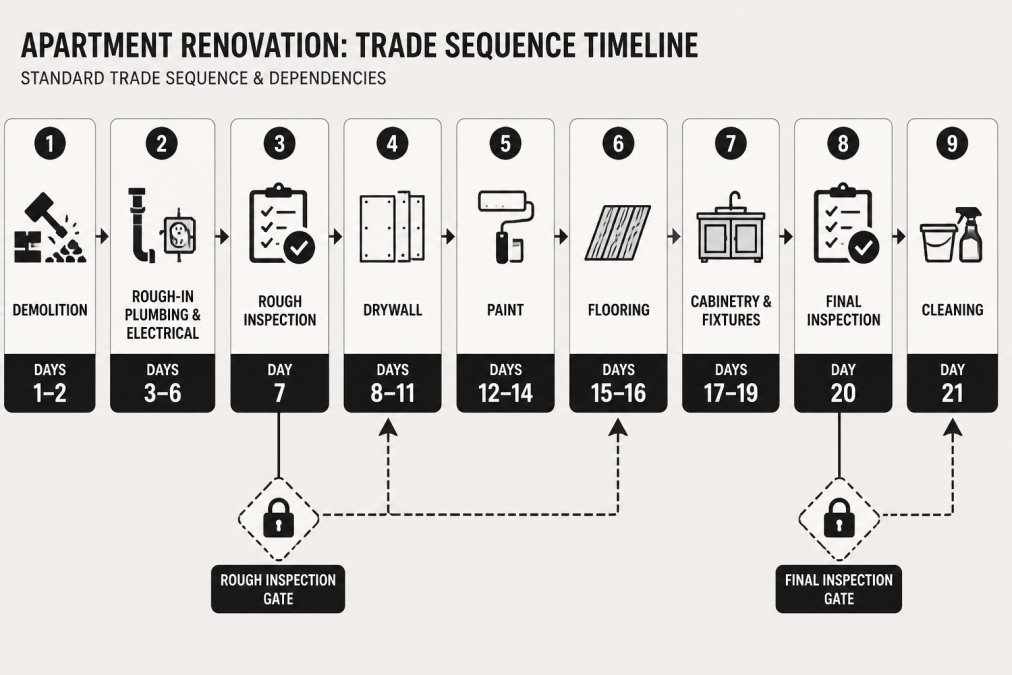
Moving cabinetry before flooring is a frequent, expensive mistake: cabinets installed first must be pulled and reset when the floor goes down.
Managing Delays and Buffer Time Between Trades
Build a buffer between every trade, not just at the end. A two-day gap after drywall absorbs the sanding overrun that would otherwise push the painter into the next unit's window. Insist each trade confirms readiness in writing before the next crew is dispatched, a signed inspection line, not a text message.
Your Apartment Renovation Checklist for Every Phase
An apartment renovation checklist is only useful if it functions as a gate, not a wish list. Every phase needs a named owner, a written sign-off, and a hard rule that the next phase cannot start until the previous one closes.
Pre-Construction Gates
- Scope documents signed by every trade, with exclusions spelled out
- License numbers and certificates of insurance collected and verified with the carrier
- Building management notified in writing of work dates, elevator reservations, and dumpster placement
Rough-In Gates
- Demolition complete and debris removed from the building, not staged in the hallway
- Rough plumbing and electrical installed and photographed before walls close
- Rough inspection passed and the signed card photographed and filed
Finish Gates
- Drywall sanded, primed, and signed off by the painter before flooring is delivered
- Flooring installed and cured before cabinetry is set
- Cabinets, countertops, and fixtures installed and leveled
Closeout Gates
- Punch list walked with the property manager and every item assigned to a trade
- Post-construction cleaning completed in stages, not one pass
- Vents, cabinet interiors, window tracks, and light fixtures detailed
| Phase | Owner | Key Gate | Common Failure |
|---|---|---|---|
| Pre-construction | General contractor | Signed scopes and verified insurance | Missing COI or expired license |
| Rough-in | Plumbing and electrical | Passed rough inspection | Trade booked before the gate clears |
| Finishes | Painter and flooring | Surface sign-off | Cabinets set before floor |
| Closeout | Cleaning vendor | Final walk and punch list | Dust left in vents and cabinets |
The checklist only works if someone owns it, usually the general contractor or the property manager's renovation lead. Without an owner, each trade assumes someone else is tracking the gate, and the unit sits past turnover.
Request Walk Thru Estimate Today →
Trade Sequencing and Dependency Management
The checklist only prevents rework if it is tied to a real sequence: demolition, rough plumbing and electrical, rough inspection, insulation and drywall, paint, flooring, cabinetry and fixtures, final inspection, and post-construction cleaning. Moving cabinetry before flooring is the most common and expensive reversal.
Resident-Impact Planning
Apartment renovations run inside a building other people live in, so the checklist must include the people around the unit. Reserve elevator time in blocks, post notices to neighboring units at least 48 hours ahead of noisy work, and confirm which hours the building allows hammering, cutting, and deliveries. Protect common-area corridors and lobby floors before the first crew arrives, and sweep the path to the elevator daily; dust in the hallway generates complaints that can stall the next phase.
Building Access, Permits, and Resident-Impact Planning
Apartment renovations run inside a building other people live in, which changes the rules: a unit renovation can disrupt a whole floor if the elevator is tied up or the dumpster blocks the garage.
Plan access before the first crew arrives: reserve elevator time in blocks and post notices to neighboring units at least 48 hours ahead of noisy work.
Budget Controls, Change Orders, and Payment Schedules
Budget control in apartment renovations comes down to three habits: a real contingency, a written change order for every deviation, and payments tied to finished work.
A change order is a written amendment stating the added work, cost, and schedule impact.
Tie payments to milestones: rough-in complete and inspected, drywall finished, finishes installed, final walk passed.
Communication Systems and Responsibility Tracking
One channel, one log, one owner. Pick a single communication system, a shared spreadsheet, a project management app, or a group thread, and require every trade to use it. Verbal hallway instructions are how responsibility gets lost when trades share a doorway and an elevator.
Meeting Cadence
Set a cadence before the first crew arrives and hold it even when things are going well.
- Daily stand-up (10 minutes, on site or by phone): each trade reports what closed yesterday, what is scheduled today, and what is blocked. The general contractor or renovation lead runs it.
- Weekly coordination call (30 minutes): the property manager, general contractor, and the trades scheduled for the next two weeks review the gate list, the change-order log, and the inspection calendar.
- Pre-phase walk (15 minutes): before each new trade starts, walk the unit with the outgoing and incoming trades to confirm the gate is actually clear.
Decision Log
Every decision affecting cost, schedule, or scope gets written down the day it is made, with the date, the decision, who made it, which trade it affects, and the cost or schedule impact. A decision that lives only in a hallway conversation will be relitigated.
Change-Order Tracking
Track every change order in the same log as the decisions, with a running total against the contingency.
Request Walk Thru Estimate Today →
Responsibility Matrix
A responsibility matrix is the single most useful coordination tool on a multi-trade apartment project: a table of task, trade, due date, status, and sign-off, updated daily. When a delay hits, it shows exactly which trade missed which gate, turning a blame conversation into a scheduling fix.
| Task | Trade | Due Date | Status | Sign-Off |
|---|---|---|---|---|
| Rough plumbing | Plumber | Day 5 | Complete | Inspection card |
| Rough electrical | Electrician | Day 6 | Complete | Inspection card |
| Drywall hang and finish | Drywall crew | Day 11 | In progress | Painter walk |
| Flooring install | Flooring crew | Day 16 | Scheduled | GC walk |
| Final clean | Cleaning vendor | Day 21 | Scheduled | Property manager |
Escalation Path
Write the escalation path before the project starts. When a trade misses a gate, the first step is a same-day conversation between the trade and the renovation lead. If the gate is still missed the next day, the property manager and general contractor decide whether to resequence, add a crew, or absorb the delay.
Documentation and Dispute Prevention
Keep every scope document, inspection card, change order, and daily photo in one shared folder organized by unit and date; when a dispute arises between trades, the documentation resolves it. Verify licenses and certificates of insurance before the first crew arrives, a trade that is uninsured when an injury happens becomes the property owner's problem.
Post-Construction Cleaning Schedule and Project Closeout
A post-construction cleaning schedule belongs in the project calendar from day one, not booked as an afterthought once the last trade leaves. Fine drywall dust settles for days, so a clean performed too early gets undone.
Sequence the closeout clean in stages: a rough clean after demolition and framing, a second pass after drywall and paint, and a final detail clean after fixtures and flooring are set.
Closeout ends with documentation: final inspection sign-off, punch list resolution, condition photos, and keys returned to the property manager. Hand the unit back complete, and the next tenant walks into a space that looks finished rather than almost finished.
Apartment renovations only stay on schedule when one system ties the trades, the building, and the paperwork together. If the final handoff is where your projects stall, Squeaky Clean Plus handles Turnover Apartment Cleaning with dedicated project coordination, so every unit is ready for the next tenant on time. Our team works directly with your contractors and property staff to schedule around real completion dates, not estimates. Start an Estimate with Squeaky Clean Plus and close out your next renovation without the last-minute scramble.
Frequently Asked Questions
What is the best order for contractors during an apartment renovation?
The standard sequence runs demolition, rough plumbing and electrical, inspection, insulation and drywall, painting, flooring, kitchen cabinets and countertops, bathroom fixtures, trim and doors, final inspection, then post-construction cleaning. Each trade depends on the one before it passing inspection. Skipping or compressing steps, especially the inspection hold points, causes rework that costs more than the time saved. Lock the sequence into your contractor scheduling for renovations before anyone mobilizes on site.
How do you keep apartment renovation contractors on schedule?
Build a schedule with explicit buffer days between trades rather than back-to-back starts, and put inspection dates on the calendar as hard deadlines. Require daily or every-other-day photo updates from each crew lead. When a trade runs late, the buffer absorbs one or two days without pushing the whole project. If delays exceed the buffer, escalate immediately rather than waiting for the next scheduled check-in. Written schedules with named responsible parties outperform verbal agreements every time.
What should a property manager include in a contractor scope of work?
A complete scope lists unit numbers, square footage, specific materials with model numbers, finish schedules, demolition limits, protection requirements for common areas, daily cleanup expectations, working hours, and a named site contact. It should also state what is explicitly excluded so no one assumes coverage. Attach the apartment renovation checklist as an appendix so every trade sees the full sequence. Ambiguity in scope is the single largest source of change orders on multifamily projects.
When should post-construction cleaning be scheduled?
Schedule post-construction cleaning after the final inspection passes and all trades have demobilized, but before any staging or showing furniture arrives. For a typical apartment unit, that means a rough clean to remove debris and dust immediately after construction, then a final detail clean 24 to 48 hours before the unit goes on the market. If painting or flooring crews are still working, cleaning too early wastes money because dust settles again within hours.