 how-to
Reducing Vacancy Time in Rental Units: 2026 Guide
Table of Contents
- Why Reducing Vacancy Time in Rental Units Protects Cash Flow
- What Is the Average Rental Vacancy Duration?
- Step 1: Start Pre-Marketing Before the Notice Period Ends
- Step 2: How to Automate Apartment Unit Turnover Scheduling
- Step 3: Use an Apartment Turnover Checklist to Cut Days on Market
- Step 4: Price Competitively and Advertise Across Multiple Channels
- Step 5: Screen Tenants Fast Without Violating Fair Housing Rules
- Step 6: Track Operational Benchmarks to Keep Vacancy Low
- Frequently Asked Questions
Last Updated: October 5, 2026
Why Reducing Vacancy Time in Rental Units Protects Cash Flow
Reducing vacancy time in rental units is the fastest way to protect your cash flow. Every empty day is a day you pay the mortgage, taxes, and insurance without collecting rent.
Vacancy cost is the money you lose for each day a rental unit sits empty. It includes lost rent, ongoing fixed costs, and the extra marketing you run to fill the gap.
That math explains why shaving even a few days off a turnover matters so much.
How to Calculate Your Vacancy Cost Per Day
Start with your monthly rent and divide by 30. That gives you the daily rent loss.
Then add your carry costs:
- Monthly mortgage or loan payment divided by 30
- Average monthly utilities
- Any HOA dues divided by 30
Add those figures together and you have your true daily vacancy cost. A unit at $1,800 a month with $900 in combined carry costs loses roughly $90 every empty day. Over a two-week gap, that is about $1,260 gone.
What Is the Average Rental Vacancy Duration?
The average rental vacancy duration in the U.S. typically runs around 25 to 30 days from move-out to new lease, based on U.S.
Denver's rental market has softened in recent years as new supply came online. More rental supply means more competition for every qualified tenant.
So the national average is a benchmark, not a target. Your goal is to beat your own last turnover, then beat the building next door.
Step 1: Start Pre-Marketing Before the Notice Period Ends
Pre-marketing is the single biggest lever most landlords ignore. The moment a tenant gives notice, you already know the move-out date. Use that window.
Here is how to run it:
- Confirm the notice period in writing and log the exact move-out date.
- Shoot listing photos before the unit is empty, if it still shows well.
- Post the listing with an available date that matches your realistic turnover.
- Start booking showings for the day after the unit is ready.
A common mistake is waiting until the unit is spotless to list it. That adds a week or more of vacancy you never needed to lose.
Step 2: How to Automate Apartment Unit Turnover Scheduling
Learning how to automate apartment unit turnover scheduling cuts coordination time and missed handoffs. The goal is a single shared calendar that shows every task, vendor, and deadline.
Set it up like this:
- Build a turnover template with every task and its owner
- Trigger the schedule the day notice is received
- Auto-assign cleaning, painting, and repairs to your vendor list
Software helps, but the real win is a fixed order of operations.
This is where a coordinated vendor matters. Squeaky Clean Plus builds turnover cleaning into your schedule with dedicated project coordination, so the handoff between trades does not stall.
Step 3: Use an Apartment Turnover Checklist to Cut Days on Market
An apartment turnover checklist turns a chaotic scramble into a repeatable process. It also cuts days on market because nothing gets missed and nothing gets redone. The version below is built as a timeline, not a to-do list, so every task has a day range and a clear owner.
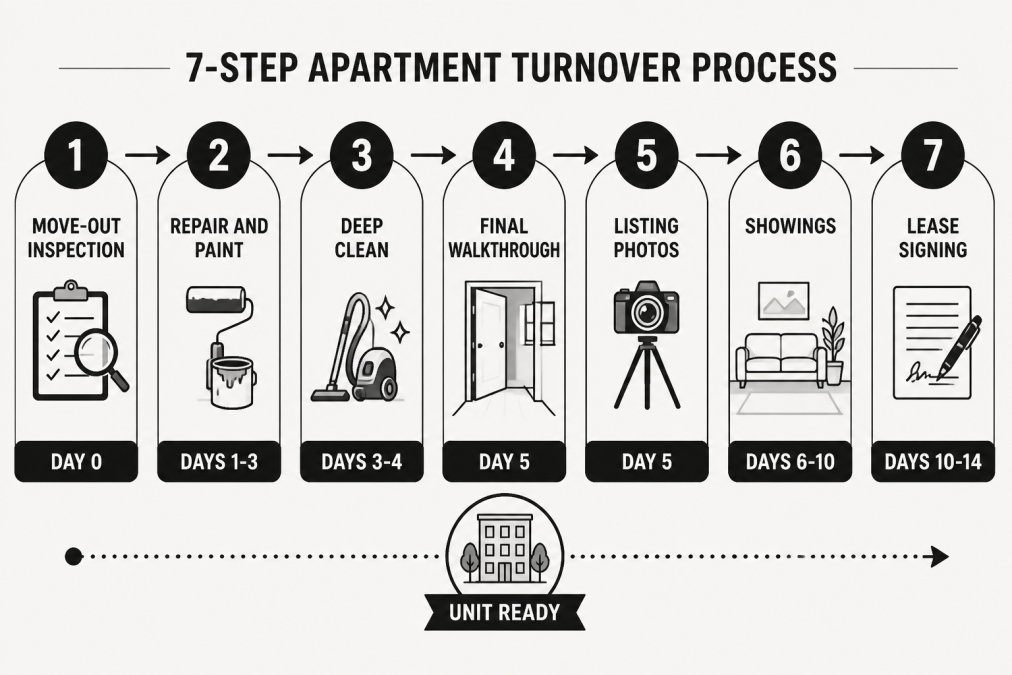
The Turnover Timeline, Day by Day
Most practitioners find a 10-to-14 day turnover window is realistic for a standard apartment. Compress it only when the unit is in near-move-in condition.
Day 0, Move-out inspection and documentation
- Walk the unit with the move-out checklist in hand
- Photograph every room, appliance, and existing damage
- Note items the tenant is responsible for vs. normal wear
Days 1-3, Repairs, paint, and mechanical checks
- Fix anything that would fail a showing: leaks, broken blinds, sticking doors, dead outlets
- Patch and paint walls; use a single neutral color across the unit
- Test smoke and carbon monoxide detectors, GFCI outlets, and HVAC filters
Days 3-4, Deep clean
- Kitchen: degrease hood, clean oven interior, pull the refrigerator, wipe cabinet interiors
- Baths: descale fixtures, scrub grout, replace the toilet seat if stained
- Floors: vacuum, then clean carpet or hard surface; treat pet odor at the source
Day 5, Final walkthrough and listing photos
Request Walk Thru Estimate Today →
- Do a white-glove inspection under bright light
- Fix anything the walkthrough flags before photos
- Shoot photos in daylight with wide angles; include a floor plan if you have one
Days 6-10, Showings and applications
- Batch showings into two or three windows to reduce drive time
- Collect applications on the spot and run screening the same day
Days 10-14, Lease signing and move-in
- Send the lease for e-signature
- Schedule the move-in inspection and key handoff
- Confirm utilities are in the tenant's name before handoff
Decision Rules That Save Days
A checklist only saves time if it tells you when to stop fixing and start replacing.
- Carpet: If stains or odor survive a professional clean, replace. A replacement pad and carpet often costs less than two extra weeks of vacancy.
- Paint: Repaint any wall with patched holes or scuffs. Touch-ups on a faded wall show under listing photos.
- Appliances: If a repair quote exceeds roughly half the cost of a comparable replacement, replace. Tenants notice dated appliances in photos.
Documentation That Prevents Delays
Keep a turnover file for every unit. It should hold the move-out inspection report, photos, vendor invoices, the cleaning sign-off, and the final walkthrough notes. When a vendor misses a step, the file shows exactly where the delay started, and you can hold that step accountable next time.
The cleaning phase is where schedules slip most. Fine dust from a remodel, or a rushed clean, forces a redo. A crew that specializes in turnover cleaning keeps that step on time, and if repairs run past the cleaning window, Remodeling & Handyman Services can pick up the punch-list work so the unit still hits its ready date.
Step 4: Price Competitively and Advertise Across Multiple Channels
Pricing too high is the most common reason a good unit sits empty. Check comparable units within a mile, then set rent at or just below the middle of that range to fill faster.
Advertise in more than one place:
- Major rental listing sites
- Local Facebook and community groups
- Your own property website
- Signs and referrals from current tenants
Multi-channel advertising widens your pool of rental inquiries. More qualified applicants means you pick faster and fill faster.
Step 5: Screen Tenants Fast Without Violating Fair Housing Rules
Fast screening and fair housing compliance are not in conflict. You can move quickly and still follow the law.
The Fair Housing Act guidance from HUD sets the rules for advertising and tenant screening. Apply the same criteria to every applicant, every time.
A fast, compliant process looks like this:
- State your criteria up front in the listing
- Run the same background and credit check for all applicants
- Document every decision
- Respond to inquiries within 24 hours
Response time matters. Slow replies lose good tenants to faster landlords. A quick, consistent process fills units without legal risk.
Step 6: Track Operational Benchmarks to Keep Vacancy Low
You cannot fix what you do not measure. Track a few key numbers every month and watch the trend. The metrics below are grouped by what they diagnose, so a bad number points you to the specific step that needs work.
Funnel Metrics: Where Vacancy Time Actually Leaks
Vacancy time is the sum of small delays. Break it into a funnel and you can see which stage is slow.
| Stage | Metric | What a Weak Number Means |
|---|---|---|
| Listing to inquiry | Inquiry rate per listing view | Photos, price, or headline are not converting |
| Inquiry to showing | Inquiry-to-showing rate | Slow replies or inflexible showing windows |
| Showing to application | Showing-to-application rate | Unit condition, price, or screening criteria mismatch |
| Application to lease | Application-to-lease time | Screening delays, lease review, or move-in date friction |
A common pattern is a healthy inquiry rate but a weak showing-to-application rate. That usually means the listing oversells the unit, or the rent is above what the condition supports.
Outcome Metrics: The Scoreboard
| Metric | What It Tells You | Reasonable Target |
|---|---|---|
| Days on market | How fast units rent | Beat your own trailing 90-day average |
| Turnover days | Move-out to unit ready | 10-14 days for a standard apartment |
| Vacancy rate | Share of empty units | Trend down quarter over quarter |
| Response time to inquiries | Speed to first reply | Under 24 hours; under 4 hours is better |
| Lease renewal rate | Tenant retention | Higher each year |
How to Use the Numbers
- Log every inquiry, showing, application, and lease date in one place.
- Review the funnel monthly, not annually.
- When a stage slips, change one variable at a time: price, photos, showing windows, or screening turnaround.
- Compare units against each other. A single slow unit usually has a specific cause, not a market problem.
Strong tenant retention is the quietest way to cut vacancy. A renewed lease means no turnover at all. Fix small issues fast, communicate well, and treat the tenant experience as part of your marketing.
For property managers juggling multiple units, reliable turnover cleaning keeps these benchmarks moving the right way. Squeaky Clean Plus is a supplier partner with the Apartment Association of Metro Denver, and our team focuses on the handoff process so units are ready on schedule.
Frequently Asked Questions
What is the average acceptable vacancy rate for rental properties?
Most property managers target a vacancy rate between 5% and 8% annually. Anything above 10% signals a problem with pricing, marketing, or turnover speed. Tracking your average rental vacancy duration monthly helps you spot trends before they drain cash flow. If your units sit empty longer than 30 days between tenants, review your pre-marketing timeline and turnover checklist for bottlenecks.
How does professional cleaning impact rental turnover time?
A dedicated turnover cleaning crew can cut 2-4 days from your unit preparation timeline compared to using general cleaning staff. Professional teams arrive with the equipment and staffing to handle deep cleans, carpet extraction, and post-construction dust in one visit. Coordinating cleaning as a scheduled step in your apartment turnover checklist prevents the unit from sitting idle while you wait for available labor.
How can automated scheduling reduce apartment turnover delays?
Automated scheduling tools send move-out reminders, trigger work orders the moment a notice is filed, and book vendors like cleaners and painters without manual back-and-forth. This removes the lag between a tenant giving notice and your team starting work. Properties that automate apartment unit turnover scheduling typically shave 3-5 days off the gap between move-out and move-in readiness.
What are the most effective ways to market a vacant unit before move-out?
Start pre-marketing 30-45 days before the current tenant leaves. Use professional listing photos from the last turnover, syndicate across multiple channels including Zillow and Apartments.com, and schedule showings during the notice period. Respond to every rental inquiry within one hour. Units marketed before move-out consistently see shorter vacancy time because qualified tenants are already in the pipeline when the unit becomes available.
Vacancy is a cost you control. Every day you shave off a turnover goes straight back into your cash flow. Squeaky Clean Plus helps property teams across Denver hit tight turnover windows with dedicated project coordination, fast turnover cleaning, and a focus on the handoff that keeps projects on track. Start an Estimate and get your next unit move-in ready on schedule.