 how-to
How to Clean Fine Drywall Dust Particles: 7 Steps
Table of Contents
- Why Fine Drywall Dust Particles Are Harder to Remove Than Regular Dust
- The Dangers of Inhaling Drywall Dust (And How to Protect Yourself)
- Tools and Supplies You Need Before You Start
- Step-by-Step: How to Clean Fine Drywall Dust Particles in Any Room
- Post Construction Cleaning Checklist for Fine Drywall Dust
- Common Mistakes That Spread Drywall Dust Instead of Removing It
- When to Bring in a Professional Turnover Cleaning Team
- Frequently Asked Questions
Last Updated: September 25, 2026
Why Fine Drywall Dust Particles Are Harder to Remove Than Regular Dust
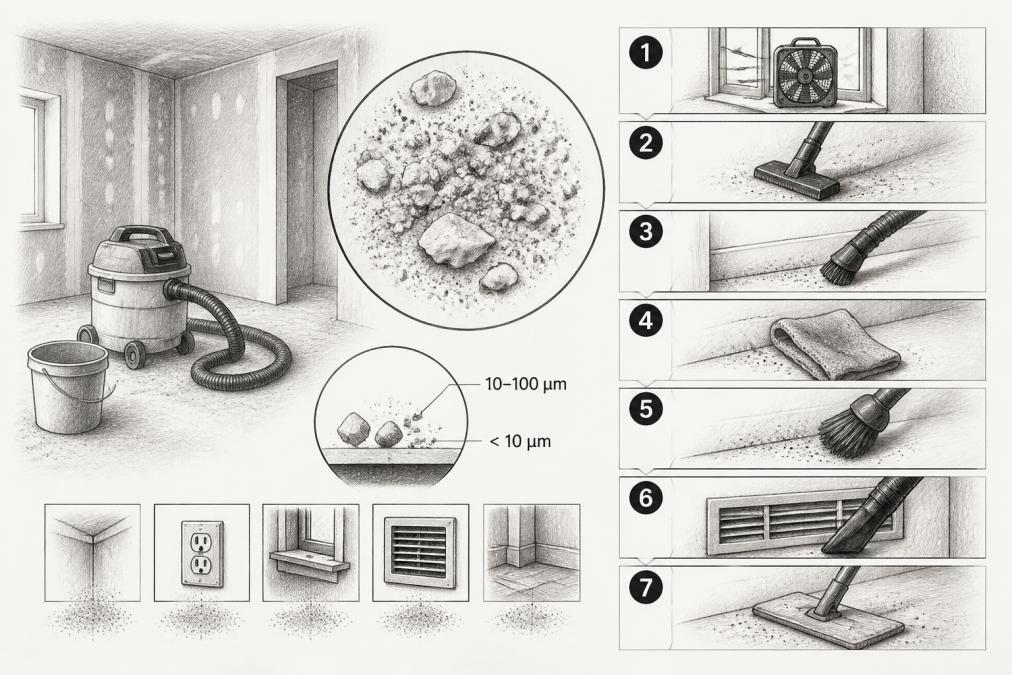
Fine drywall dust is not like the dust that collects on a bookshelf. It is a powder made of gypsum, silica, and other minerals, and the particles are small enough to float in the air for hours.
That size is the problem. These particles settle into every crack, cling to walls with a static charge, and pass through standard vacuum filters. Sweeping only pushes them back into the air, where they land again a few minutes later.
At Squeaky Clean Plus, we handle this exact problem on post-construction and turnover jobs every week. The dust behaves differently from household dust, so it needs a different removal method.
- Regular dust: heavier flakes, settles fast, easy to trap
- Drywall dust: fine powder, floats for hours, slips through cheap filters
- Static charge: makes particles stick to walls, ceilings, and fixtures
- Water contact: turns the powder into a paste that smears and hardens
That last point matters more than most people expect. Get the surface too wet and you trade a dust problem for a film that takes real scrubbing to remove.
The Dangers of Inhaling Drywall Dust (And How to Protect Yourself)
The dangers of inhaling drywall dust are real and worth taking seriously. The particles are small enough to reach deep into the lungs, and silica exposure is a known health hazard on construction sites.
The OSHA silica safety guidance covers crystalline silica, which is present in many drywall compounds and joint materials. Short exposure can irritate your eyes, nose, and throat. Repeated exposure without protection is the bigger concern.
Protect yourself before you start:
- Wear an N95 or P100 respirator, not a cloth mask
- Use sealed safety glasses, not open-sided glasses
- Wear gloves and long sleeves to cut skin contact
- Ventilate the room, but block dust from spreading to other areas
- Never eat or drink in the work area until you have cleaned up
A common mistake is skipping the mask for "just a quick wipe-down." Fine particles stay airborne long after the visible mess is gone, so quick jobs still expose you.
Tools and Supplies You Need Before You Start
Gather everything before you begin. Walking in and out of the room mid-job tracks dust into clean spaces and undoes your work.
Here is the short list we use on turnover jobs:
- HEPA vacuum with a fine-particle filter
- Two buckets: one for rinse water, one for cleaning solution
- Microfiber cloths, at least six
- Tack cloths or damp disposable wipes
- Plastic sheeting and painter's tape
- Step ladder for ceilings and vents
- N95 or P100 respirator
- Sealed trash bags
A HEPA vacuum for drywall dust is the single most important tool on this list. Standard shop vacs blow fine particles straight back into the room. A true HEPA filter traps them instead.
Step-by-Step: How to Clean Fine Drywall Dust Particles in Any Room
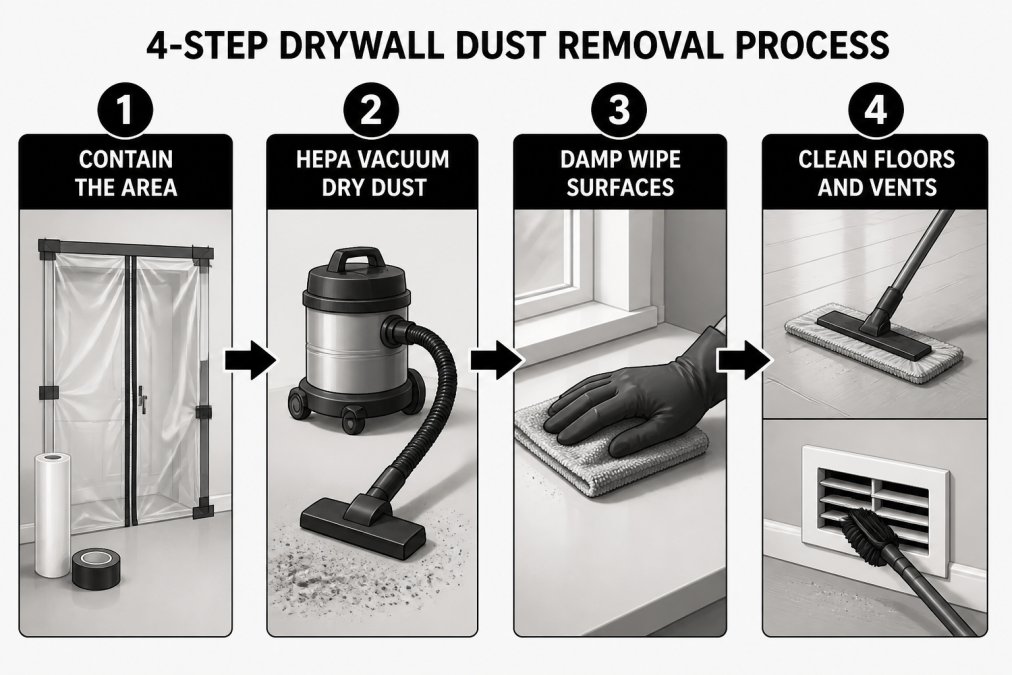
Cleaning fine drywall dust particles comes down to four steps in a set order. Skip a step or change the sequence, and you spread the dust instead of removing it.
Step 1: Contain the Dust Before You Clean
Seal the room before you touch anything. Tape plastic sheeting over doorways, close and tape off HVAC vents, and lay a drop cloth at the entry.
Turn off the central air if the system serves that room. Running air pushes particles through the whole building.
Step 2: Remove Dry Dust With a HEPA Vacuum for Drywall Dust
Vacuum everything dry before any wiping. Start at the ceiling and work down: ceiling, walls, trim, then floor.
Move slowly. Fast passes stir up dust that the vacuum then has to catch a second time. Empty or check the filter when suction drops.
Step 3: Wipe Surfaces With a Damp Cloth, Not a Soaked One
Damp, not wet. A soaked cloth turns drywall dust into a paste that smears and dries into a haze.
Rinse the cloth often in your rinse bucket, and change the water before it turns cloudy. Work top to bottom, and use a fresh cloth on each surface when you can.
Step 4: Clean Floors, Vents, and Fixtures Last
Floors come last because everything above them has already dropped dust down. Vacuum, then damp mop, then dry with a clean cloth.
Pull vent covers and wipe inside the grilles. Finish with light fixtures, switch plates, and door hardware, which collect a thin film that shows under bright light.
Post Construction Cleaning Checklist for Fine Drywall Dust
A written post construction cleaning checklist keeps a turnover crew from missing the spots that show up in a walkthrough. Use this one as a starting point.
- Room sealed with plastic and tape
- HVAC vents covered and system off
- Ceiling and corners HEPA vacuumed
- Walls vacuumed top to bottom
- All surfaces damp wiped
- Floors vacuumed and damp mopped
- Vent covers removed, wiped, and replaced
- Light fixtures and switch plates wiped
- Windows and sills cleaned inside
- Trash bagged and removed from the unit
- Final white-glove check under bright light
That last item matters. Fine dust shows up under raking light, not overhead light. Walk the room with a flashlight against the wall before you call it done.
Common Mistakes That Spread Drywall Dust Instead of Removing It
Most failed cleanups come down to a handful of repeat mistakes. Here is what we see on jobs where a previous crew left dust behind.
- Sweeping or dry dusting. This lifts particles back into the air, where they resettle everywhere.
- Using a shop vac without a HEPA filter. The exhaust blows fine dust across the room.
- Soaking surfaces. Too much water creates a paste that dries into streaks.
- Cleaning floors first. Dust from walls and ceilings lands on your clean floor.
- Skipping vents. HVAC grilles hold dust and release it every time the system runs.
- Reusing dirty water. Cloudy water just moves dust from the bucket back to the wall.
When to Bring in a Professional Turnover Cleaning Team
Some jobs are worth handing off. Large post-construction projects, tight turnover windows, and units with heavy dust all fit that category.
The EPA guidance on indoor air quality notes that fine particles can stay suspended and recirculate through a building long after visible cleanup. That is the case for bringing in a crew with the right equipment and a repeatable process.
Turnover Apartment Cleaning handles apartment turnovers and post-construction cleaning for property teams, with dedicated project coordination on every job. As a supplier partner with the Apartment Association of Metro Denver, we focus on the handoff between move-out and move-in so units are ready on schedule.
If your team is juggling multiple contractors, we coordinate with those crews directly. You are not stuck as the middleman between three vendors.
Frequently Asked Questions
What is the best way to clean fine drywall dust?
Start by sealing off the room with plastic sheeting, then vacuum all surfaces with a HEPA vacuum for drywall dust. Follow with a damp microfiber cloth on walls, trim, and fixtures, and clean floors last. Avoid dry sweeping or a standard shop vac, which push fine particles back into the air. If you are prepping a unit for a new tenant, a turnover apartment cleaning team can handle the full process.
Can you use a regular vacuum for drywall dust?
No. A regular household vacuum pushes fine drywall dust particles straight through its filter and back into the room. You need a vacuum with a HEPA filter rated for drywall dust, plus a sealed canister and a bag designed for fine particles. Even then, empty the canister outside and wear an N95 respirator while you work.
Is it safe to breathe in fine drywall dust?
No. The dangers of inhaling drywall dust include eye, nose, and throat irritation, and repeated exposure can affect lung function. Fine particles stay airborne for hours and settle on surfaces long after sanding stops. Always wear an N95 respirator and ventilate the space while cleaning. If you are managing a post-construction turnover, schedule cleaning after the dust has settled.
How do you get drywall dust out of the air?
Run a HEPA air scrubber or a box fan with a HEPA filter in the room for several hours after sanding. Open windows when weather allows, and keep the HVAC system off until all surfaces are wiped down. Change your HVAC filter once the job is done. For larger post-construction projects, a professional team with commercial air scrubbers will clear the air faster than portable units.
Fine drywall dust is stubborn, but it is beatable with the right order of steps and the right tools. If your turnover schedule is tight or the dust is beyond a quick cleanup, Squeaky Clean Plus can take it from here. We bring dedicated project coordination, HEPA-grade equipment, and a process built for apartment turnovers and post-construction handoffs. Start an estimate with Squeaky Clean Plus and get your units ready for the next tenant without the last-minute scramble.