 how-to
Coordinate Cleaning With Maintenance Crews
Table of Contents
- Why Coordinating Cleaning and Maintenance Matters
- Step 1: Create an Apartment Turnover Checklist
- Step 2: Build a Unit Turnover Cleaning Timeline
- Step 3: Develop a Contractor Coordination Checklist
- Step 4: Establish Property Manager Vendor Communication Protocols
- Step 5: Set Up Shared Calendars and Task Boards
- Step 6: Handle Post-Maintenance Cleaning and Quality Checks
- Common Mistakes to Avoid When Coordinating Crews
- Frequently Asked Questions
Last Updated: October 10, 2026
Why Coordinating Cleaning and Maintenance Matters
When you coordinate cleaning with maintenance crews, you prevent wasted time and money. Dust from drywall repair settles on freshly cleaned floors. Painters track footprints through spotless bathrooms. Plumbers leave debris scattered across newly polished surfaces.
The real cost is delay. A 48-hour turnover window disappears fast when crews step on each other's work, causing lost showings and revenue.
Winning teams follow a clear sequence: who works when, who cleans what, and how handoffs happen. Below is how to build that system.
Step 1: Create an Apartment Turnover Checklist
An apartment turnover checklist lists every task in order before a unit is ready. Cover three phases: move-out inspection, maintenance and repairs, and cleaning and final prep. Assign responsible parties to each task to prevent duplication and catch problems early.
What to Include in Your Checklist
Include move-out inspection tasks (document condition, photograph damage), maintenance tasks (drywall repairs, paint, appliances, plumbing, HVAC), and cleaning tasks by room (kitchen, bathroom, carpet, windows). For each task, note estimated time, required supplies, responsible crew, and sign-off space.
Sequencing Maintenance Before Cleaning
Maintenance first, cleaning last. Within maintenance, sequence logically: drywall repair and sanding before painting, painting before flooring, plumbing and electrical before final inspections. Poor sequencing causes crew delays and rework.
Step 2: Build a Unit Turnover Cleaning Timeline
A unit turnover cleaning timeline maps when each cleaning task happens and how long it takes. Coordinate cleaning with maintenance crews by setting realistic start and end dates based on real data from your properties.
Estimate Cleaning Duration by Property Type and Condition
Cleaning time varies by unit size, condition, and maintenance work. Track actual cleaning times on your properties for 10-15 turnovers to replace generic estimates with real data.
As a starting point:
- Studio, normal condition: 6-8 hours (minimal rooms, fewer fixtures)
- 1-bedroom, normal condition: 10-12 hours (kitchen, bathroom, bedroom, living area)
- 2-bedroom, normal condition: 14-18 hours (two bathrooms, larger kitchen, more square footage)
- Post-maintenance or heavy turnover: Add 4-6 hours for debris removal, dust cleanup, and touch-ups
- Pet damage or staining: Add 2-4 hours for specialized cleaning, odor treatment, or carpet spot repair
These are crew-hours, not calendar hours. A 2-person crew working 8 hours is 16 crew-hours of work. If your timeline assumes one crew, account for that.
Map Out Work Phases with Realistic Sequencing
Break cleaning into phases that can happen in parallel across multiple units, not sequentially within one unit.
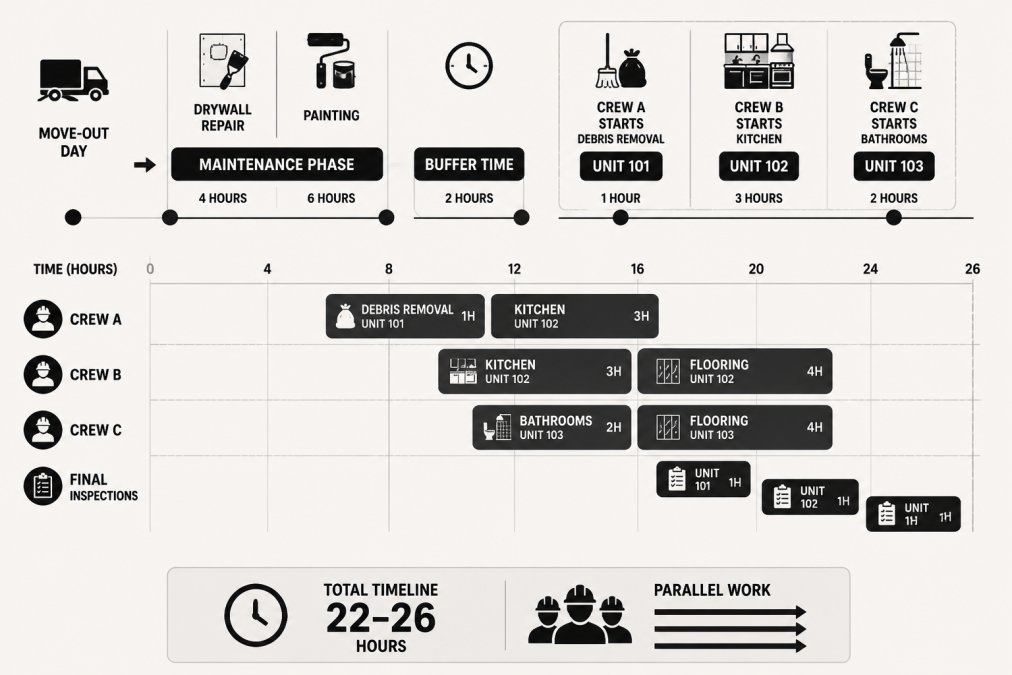
Phase 1: Post-maintenance debris removal (1-2 hours). Sweep drywall dust, remove construction debris. Critical, don't compress. Dust settling takes time.
Phase 2: Kitchen deep clean (2-4 hours). Cabinet interiors, appliances, sink, counters, backsplash, flooring.
Phase 3: Bathroom sanitizing (1.5-3 hours per bathroom). Toilet, tub/shower, sink, mirrors, fixtures, flooring, grout.
Phase 4: Flooring and carpet (2-4 hours). Vacuuming, shampooing if needed, hard flooring, baseboards.
Request Walk Thru Estimate Today →
Phase 5: Final touch-ups and inspection (1-2 hours). Light fixtures, door frames, window sills, final vacuum, walk-through checklist.
Stagger Crews Across Multiple Units
Stagger crews across units to keep them busy and maximize throughput. Example: 8 a.m., Crew A starts debris removal in Unit 101, Crew B starts kitchen in Unit 102, Crew C starts bathrooms in Unit 103. 10 a.m., crews rotate to next units. This reduces idle time and prevents one unit from holding up the entire turnover.
Account for Overlap and Buffer Time
Build buffer time between phases: 15-30 minutes between phases in the same unit for transitions and quality checks; 1-2 hours between maintenance and cleaning for dust to settle; 4-6 hours total buffer in your overall timeline to absorb small delays without pushing move-in back.
Define and Track Performance Targets
Define and track these targets: turnover completion time (24-36 hours normal, 36-48 hours post-maintenance), on-time crew arrival (95%), phase completion on schedule (90%), rework rate (less than 5%), missed tasks (less than 3%). Track weekly and adjust timelines, buffer time, or crew assignments based on results.
Step 3: Develop a Contractor Coordination Checklist
A contractor coordination checklist ensures crews have what they need and know what to do. Include: site access instructions, safety hazards, scope of work, contact information, photo documentation requirements, and sign-off procedures.
Pre-Work Communication and Site Access
Contact each crew 48 hours before start. Confirm date, time, unit number, parking, and send photos of current condition and task list. Provide access instructions, property manager contact, and note who else will be on-site. For maintenance crews, note hazards (lead paint, asbestos, mold). For cleaning crews, note surfaces needing special care.
During-Work Handoffs and Status Updates
Assign one on-site coordinator (property manager or leasing agent) to check in with each crew at start and end of shift, verify quality, and confirm next crew arrival. Use a status update form (crew name, start time, tasks completed, problems found, estimated end time). Quick communication prevents rework and keeps timeline on track.
Step 4: Establish Property Manager Vendor Communication Protocols
Clear communication protocols prevent schedule conflicts and missed deadlines. Define how crews contact you, how you escalate problems, and explicit rules for resolving conflicts, not just who to call, but which decision to make and why.
Define Priority Rules for Schedule Conflicts
Define priority rules before conflicts happen: (1) Move-in deadline is fixed; (2) Maintenance quality, never rush maintenance to meet cleaning deadline; (3) Cleaning thoroughness, never rush or skip cleaning; (4) Cost efficiency, optimize only after the above three are met.
Create a Conflict Response Flowchart
When a crew reports a delay: (1) Quantify the delay; (2) Assess impact on move-in; (3) Identify root cause (crew performance, discovery, external); (4) Apply priority rules; (5) Notify all affected crews immediately with new start times and update shared calendar.
Set Response Time Targets
Set response time targets: crew problems within 15 minutes, 30+ minute delays escalated within 15 minutes, unexpected work assessed within 30 minutes, move-in deadline at risk requires call within 15 minutes. These prevent delays from cascading.
Real-Time Status Tracking and Verification
Use a shared task board or calendar that all crews can see. Update it hourly so everyone knows the current status. Include estimated completion times, any delays, and the next crew's arrival time.
Require photo documentation at key milestones: before maintenance starts, after maintenance finishes, before cleaning starts, after cleaning finishes. Photos create a clear record and catch quality issues before they become problems.
Step 5: Set Up Shared Calendars and Task Boards
A shared calendar keeps everyone on the same page. Use a tool that all crews can access: Google Calendar, a property management software, or a shared task board.
Include unit number, move-out date, maintenance start date, cleaning start date, and target move-in date. Color-code by crew or by unit so you can spot conflicts at a glance.
Request Walk Thru Estimate Today →
A task board works similarly but adds detail: specific tasks, responsible crew, start date, end date, and completion status. This is especially useful when coordinating multiple units or properties. Property managers can see which units are on track and which need attention.
Step 6: Handle Post-Maintenance Cleaning and Quality Checks
Post-maintenance cleaning is the final step before move-in. It removes dust, debris, and any mess left by maintenance and repair work.
After all maintenance work finishes, do a walk-through before cleaning crews arrive. Note any areas that need extra attention: drywall dust, paint splatters, construction debris.
During post-maintenance cleaning, the cleaning crew should flag any maintenance work that looks incomplete or substandard.
A final quality check happens after cleaning finishes. Walk the unit with the cleaning crew lead. Verify every room meets standards: no dust, no debris, appliances clean and working, windows clear, floors spotless.
Common Mistakes to Avoid When Coordinating Crews
The biggest mistake is starting cleaning before maintenance is truly finished. Crews say "we're done" but leave dust, debris, or incomplete work. Always do a visual walk-through before the next crew arrives.
A second mistake is poor communication between crews. Maintenance doesn't tell cleaning about a new problem found during work. Cleaning doesn't report incomplete maintenance.
A third mistake is no buffer time in the schedule. Every phase runs exactly on time, so one delay cascades through the entire timeline.
A fourth mistake is unclear responsibility. Who coordinates the crews? Who verifies quality? Who makes decisions if something goes wrong?
Coordinating cleaning with maintenance crews is a process, not an event. If you're managing multiple turnovers or looking to streamline the handoff between maintenance and cleaning, Turnover Apartment Cleaning specializes in coordinating with your maintenance teams, respecting your timeline, and delivering units that are truly move-in ready.
Frequently Asked Questions
How do you coordinate cleaning with maintenance crews to prevent work conflicts?
Start by sequencing tasks: maintenance and repairs happen first, then post-maintenance debris removal, then deep cleaning. Use a shared calendar showing each crew's scheduled dates and times. Assign one person as the point of contact for all crews. Schedule a brief pre-work call with both teams to confirm site access, equipment needs, and handoff times. Track completion status in real-time using a task board so each crew knows when the previous team has finished. This prevents crews from arriving to incomplete work or interfering with each other's tasks.
What should a unit turnover cleaning timeline include?
Your unit turnover cleaning timeline should map out: move-out date, maintenance and repair phase (with specific dates), post-construction cleanup if applicable, deep cleaning phase, final inspection, and move-in ready date. Build in buffer time between phases, typically 24 hours minimum, to allow for unexpected issues. Include crew names, contact information, and specific arrival times. Account for drying time after wet cleaning, paint curing time, or dust settling after repairs. Document any dependencies, such as HVAC cleaning that must happen after painting but before final walkthrough.
What's the best way to communicate schedule changes to maintenance and cleaning crews?
Establish a property manager vendor communication protocol that defines who sends updates, how they're delivered, and response time expectations. Use a single shared calendar or task board so all crews see changes immediately. For urgent changes, follow up with a direct phone call or text to the crew lead. Document every change in writing, including the reason, new date/time, and any impacts on other crews. Confirm receipt and agreement before crews leave the site. This prevents missed deadlines, duplicate work, or crews showing up to outdated schedules.
How do you handle repairs discovered after a unit has been cleaned?
Include a post-cleaning inspection step in your contractor coordination checklist. Schedule the final walkthrough before officially marking the unit move-in ready. If issues are found, document them immediately with photos and specific location details. Contact the maintenance crew or contractor right away to schedule a repair without disrupting the cleaned space. If repairs are minor and can be done quickly, have the maintenance crew re-enter and re-clean only the affected area. For major issues, coordinate a full re-clean after repairs are complete. Use this discovery process to refine your initial maintenance checklist for future turnovers.