 how-to
How to Speed Up Apartment Unit Turnover: 2026 Guide
Table of Contents
- Why Apartment Unit Turnover Speed Decides Your NOI
- The Apartment Turnover Checklist: From Non-Renewal Notice to Move-In Ready
- Average Apartment Turnover Time: Benchmarks and What Slows You Down
- Property Management Maintenance Scheduling That Prevents Bottlenecks
- How to Coordinate Cleaning, Junk Removal, and Vendor Crews
- Legal Compliance and Resident Communication During Turnover
- Conclusion: Build a Turnover Cycle That Runs Without You
- Frequently Asked Questions
Last Updated: September 17, 2026
Why Apartment Unit Turnover Speed Decides Your NOI
Every vacant day you collect nothing while the mortgage, insurance, and utilities keep running. That math is why learning how to speed up apartment unit turnover matters more than almost any other operational skill in multifamily property management. Turnover time is the single largest controllable expense on most rent rolls, and it compounds: a unit sitting empty for two extra weeks drains net operating income (NOI) in a way no small repair budget can offset.
The Apartment Turnover Checklist: From Non-Renewal Notice to Move-In Ready
A repeatable apartment turnover checklist is the backbone of a fast turnaround: a documented sequence where nothing waits on a phone call or a forgotten email.
- Send the non-renewal notice acknowledgment and confirm the move-out date in writing
- Schedule the pre-move-out inspection within the final two weeks of tenancy
- Open work orders for known repairs before the resident leaves
- Book the make-ready scope: painting touch-ups, cleaning, and repairs
- Coordinate junk removal and haul-away for abandoned items
- Complete final walkthrough and damage assessment against the security deposit
- Release the unit to leasing for showings
Pre-Move-Out Inspection and Damage Assessment
The pre-move-out inspection is where you buy back time. Walk the unit while the resident is still there, note damage assessment items in writing, and let the tenant fix small issues themselves.
Make-Ready Scope: Painting Touch-Ups, Repairs, and Cleaning
The make-ready scope should be written before the unit is empty, not after. Painting touch-ups, cost-effective repairs, and deep cleaning decide how fast a unit flips.
Average Apartment Turnover Time: Benchmarks and What Slows You Down
Average apartment turnover time is the number of days between a resident moving out and the next resident moving in. Most operators break that window into three measurable phases, because lumping them together hides where the days actually go:
- Vacant-not-ready days, move-out to make-ready complete
- Ready-not-leased days, make-ready complete to signed lease
- Lease-to-move-in days, signed lease to keys handed over
The Real Cost of a Vacant Day
A vacant day is not just lost rent. It is lost rent plus the fixed costs that keep running: mortgage or debt service, insurance, property taxes, utilities, and shared payroll allocation. Operators underestimate this because they only count the rent line. Run the math on your own property: take monthly rent, divide by 30, then add the daily share of fixed costs.
How to Calculate Your Turnover Rate and Vacancy Days
Turnover rate calculation is simple: divide the units turned in a period by total units, then multiply by 100. Turned 12 of 80 units? That is a 15 percent turnover rate.
A KPI Dashboard for Turnover
A practical turnover dashboard tracks five numbers, reviewed weekly:
- Average vacant-not-ready days, your primary operational KPI
- Average ready-not-leased days, your leasing KPI
- Turnover rate, units turned ÷ total units × 100
- Cost per turn, total make-ready spend ÷ units turned
- Turn cost as a percentage of annual rent, a common benchmark operators use to flag units that are eating into NOI
Reviewed weekly, patterns surface fast: a spike in vacant-not-ready days usually points to a vendor or scheduling bottleneck, while a spike in ready-not-leased days points to pricing or marketing.
Where the Days Actually Disappear
What slows teams down:
- Waiting on a vendor to confirm a date
- Discovering repairs that were never scoped
- Junk left behind that blocks the cleaning crew
- Leasing unable to show a unit that is not yet released
- Work orders that sit in a queue because no one owns the dispatch
Track these delays for a month and the pattern becomes obvious. The bottleneck is almost never the work itself.
Using Your Property Management Software to Find the Bottleneck
Most modern property management systems, AppFolio, Yardi, RealPage, Buildium, and RentManager are the common platforms in multifamily, can timestamp every turnover stage if you configure them to. Build the turnover as a workflow with status changes, not a free-text note.
The Psychological Side of Turnover Speed
One angle most turnover guides skip: speed affects retention. Residents who watch a neighboring unit sit empty for weeks form a perception about how the property is managed, the dumpster overflowing with abandoned furniture, the same maintenance truck parked outside for days, the leasing office showing a unit that clearly is not ready.
Property Management Maintenance Scheduling That Prevents Bottlenecks
Property management maintenance scheduling works best built backward from the move-in date. Set the target ready date, subtract the cleaning window and the repair window, and you have the date the unit must be empty and cleared.
How to Coordinate Cleaning, Junk Removal, and Vendor Crews
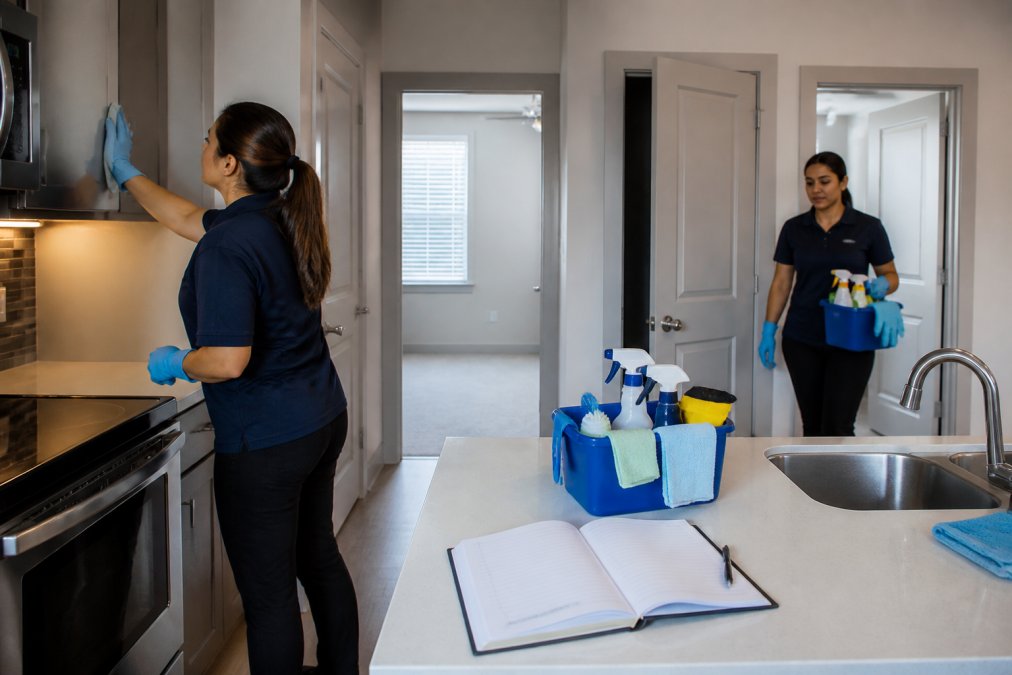
Coordinating cleaning, junk removal, and vendor crews is where most turnovers lose their days. The fix: a single point of coordination, a locked sequence, and software that dispatches work automatically instead of waiting on a phone call.
Lock the Sequence Before You Book Anyone
The order of operations is not negotiable if you want to avoid rework:
- Junk removal and haul-away, runs first, before any cleaning, so crews are not working around abandoned furniture
- Repairs and painting, grouped by trade, painters before finishers, so dust settles once
- Deep clean, last, after all dust-generating work is done
- Final walkthrough and release to leasing, after the clean, not before
Automate the Dispatch, Not Just the Checklist
Most competitors stop at "use a shared calendar." The stronger move is wiring your property management system so a status change triggers the work order. In AppFolio, Yardi, and RealPage, this is typically done through workflow rules or automated task templates tied to unit status. When a unit flips to "Unit Vacant," the system can:
- Generate the junk removal request to your hauling vendor
- Open the paint and repair work orders by trade
- Queue the cleaning work order with a start date tied to the repair completion
- Notify leasing that the unit is in the pipeline
AppFolio workflow automation documentation
Vendor Scheduling: One Coordinator, One Calendar
Vendor management improves when every crew knows the order of operations and one person owns the schedule. That coordinator's job is not to do the work but to hold the sequence and escalate the moment a vendor slips.
Supply Chain: Keep the Common Parts on the Shelf
One of the most overlooked turnover delays is a repair that cannot start because a part is not in stock. A standard maintenance inventory for apartment turns typically includes:
- Replacement blinds and brackets in the two or three most common sizes
- Faucet cartridges and aerators
- Toilet flappers, fill valves, and wax rings
- Outlet covers, switch plates, and standard light fixtures
- Door hinges, strike plates, and common knob or handle sets
- Touch-up paint matched to each unit's wall color
Junk Removal: The Step Everyone Underestimates
Abandoned furniture is the most common reason a cleaning crew arrives and cannot start. Build junk removal into the move-out day itself, not the day after. If your lease allows it, schedule haul-away for the morning after keys are returned so the unit is clear before any other trade arrives.
Where a Dedicated Coordinator Earns Their Keep
This is where a dedicated project coordinator earns their keep. Squeaky Clean Plus builds its turnover and post-construction cleaning around that handoff, so the unit moves from empty to move-in ready without the property team chasing updates. As a supplier partner with the Apartment Association of Metro Denver, the team works inside the same turnover windows property managers already run and coordinates directly with the other trades so the sequence holds.
Legal Compliance and Resident Communication During Turnover
Legal compliance during turnover starts with clear, timely communication. Most states require written notice before entry, defined timelines for returning a security deposit, and documented condition reports. Confirm the rules for your property before you build your process.
Conclusion: Build a Turnover Cycle That Runs Without You
The hardest part of turnover is not the cleaning. It is holding a schedule together when painters, cleaners, and leasing all depend on each other. When one coordinator owns the handoff, units stop sitting empty and start generating rent again.
Frequently Asked Questions
What is the average apartment turnover time?
Most apartment communities target 5 to 10 days from move-out to move-in ready, though full turns with flooring or appliance replacement can stretch past two weeks. The biggest variables are scheduling gaps between trades, waiting on parts, and cleaning crews arriving after painters finish. Tracking your own average apartment turnover time by unit type gives you a realistic baseline. Once you know it, you can attack the longest stage first instead of guessing.
How do you create an efficient apartment turnover checklist?
Start with the non-renewal notice and work backward. Your apartment turnover checklist should cover pre-move-out inspection, damage assessment, security deposit accounting, work orders, painting touch-ups, cleaning, and final unit inspection. Assign an owner and a deadline to every line item. Digital checklists that sync with your property management software beat paper because maintenance techs, leasing agents, and vendors all see the same status in real time, which cuts the phone calls and duplicate trips that stretch a turn.
What are the most common delays in the unit make-ready process?
Three delays show up again and again: waiting on vendor availability, waiting on parts for HVAC maintenance or plumbing repairs, and cleaning scheduled before construction dust settles. Supply chain management for maintenance matters more than most managers expect. Keeping common parts on hand, such as outlet covers, blinds, and weatherstripping, removes a full day from many turns. Booking cleaning and junk removal at the same time as the painter, not after, also prevents the crew from arriving to a unit that is not ready.
What role does professional cleaning play in speeding up unit turnover?
A dedicated turnover cleaning crew shortens the final stage and reduces rework. Trained cleaners handle post-construction dust, appliance interiors, and bathroom detail in one pass, so your maintenance team is not pulled off work orders to scrub cabinets. When the cleaning vendor coordinates directly with painters and flooring crews, the handoff happens the same day rather than the next morning. That single scheduling change often saves a full vacancy day per unit across a portfolio.
Start an estimate with Squeaky Clean Plus and get units move-in ready faster, with reliable cleaning transitions that keep your projects on track from move-out to the next tenant.