 how-to
Managing Multi-Unit Turnover Cleaning Schedules
Table of Contents
- Why Manual Turnover Schedules Break Down Across Multiple Units
- Apartment Turnover Cleaning Checklist: What Every Unit Reset Needs
- How to Automate Apartment Unit Turnover Scheduling
- Reducing Resident Turnover Time and Costs Without Cutting Corners
- Coordinating Cleaning Crews, Trades, and Vendor Management
- Quality Assurance and Move-In Ready Standards for Multi-Family Portfolios
- Conclusion: Building a Turnover Workflow That Scales
- Frequently Asked Questions
Last Updated: September 27, 2026
Why Manual Turnover Schedules Break Down Across Multiple Units
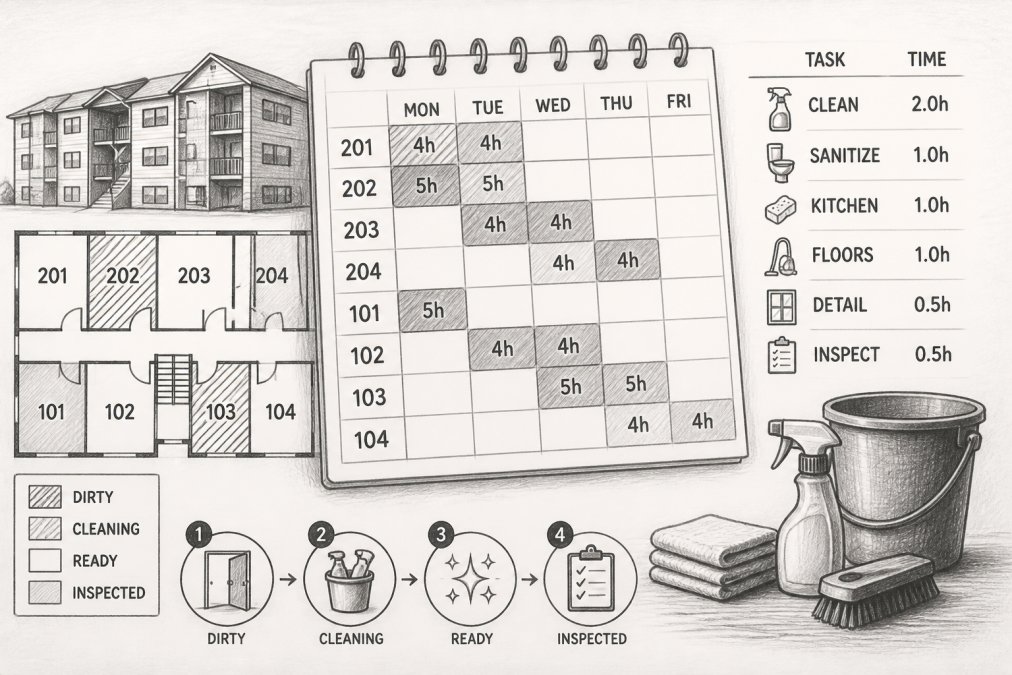
Managing multi-unit turnover cleaning schedules with spreadsheets and group texts works at three units, but turnover cleaning schedules need more than that at scale. At thirty, it falls apart. Squeaky Clean Plus coordinates apartment turnovers weekly, and the same failure points recur.
Here is what typically goes wrong:
- Double-booked crews on the same Saturday
- Cleaning finished but maintenance never notified
- Units sitting "done" for days waiting on a final walk
- No record of which trades touched which unit
Apartment Turnover Cleaning Checklist: What Every Unit Reset Needs
Every unit reset should follow the same written standard operating procedure, whether studio or three-bedroom. Consistency is what makes a checklist useful.
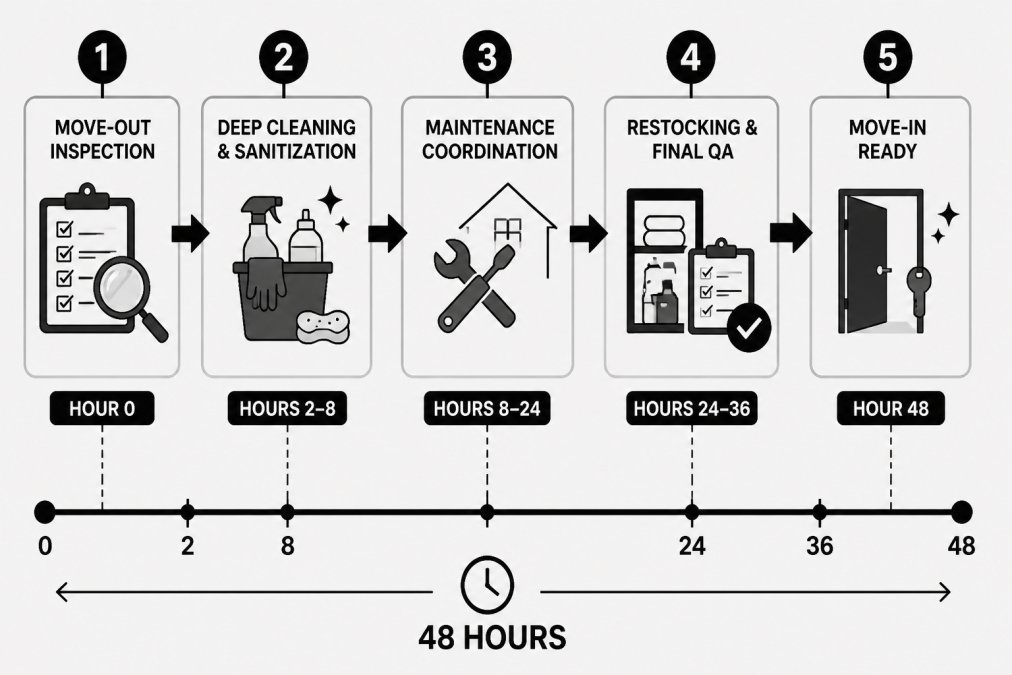
A complete apartment turnover cleaning checklist covers:
- Move-out inspection - document damage, note repairs, photograph everything
- Debris removal - haul out trash, abandoned items, and old blinds
- Deep cleaning - appliances inside and out, cabinets, baseboards, vents
- Sanitization standards - bathrooms, kitchen surfaces, high-touch points
- Floor care - vacuum, mop, carpet spot treatment or replacement coordination
- Restocking - light bulbs, filters, smoke detector batteries, toilet paper holders
- Final QA walk - score the unit against the standard before it goes live
How to Automate Apartment Unit Turnover Scheduling
Automation starts with one rule: every unit has a single status everyone can see. A shared board beats a shared inbox, but true automation means the system moves work forward on its own, not a human nudging it.
- Stage 1, Centralize status. Move the turnover schedule out of spreadsheets and group texts into a system of record. Every unit gets one row and one current status: Notice Received, Move-Out Confirmed, Inspection Complete, Repairs In Progress, Cleaning Scheduled, Cleaning Complete, QA Passed, Move-In Ready.
- Stage 2, Trigger on status change. When a unit flips to Move-Out Confirmed, the system should auto-create the cleaning task, assign the crew, and send the notification. No one should have to remember to book it.
- Stage 3, Connect work orders to the unit record. Cleaning, maintenance, and vendor tasks all pull from one queue tied to a unit number, so a painter's work order and a cleaner's task reference the same unit instead of living in two inboxes.
- Stage 4, Measure cycle time. Track days from move-out to move-in ready per unit, per property, and per crew. That number is the only honest scoreboard for a turnover operation.
Where the Software Actually Fits
You do not need an enterprise platform to start, but you need to know which tool category you are buying. Most teams land in one of three buckets:
- Full property management systems (for example, AppFolio, Yardi, or RealPage), these already hold your unit list, lease dates, and work orders, so turnover tasks can live inside the same record your leasing team uses. The trade-off is setup time and per-unit licensing cost.
- Work order and maintenance platforms (for example, Maintenance Connection or UpKeep), stronger on trade scheduling and vendor dispatch, weaker on leasing-side visibility.
- Generic project tools (for example, Asana, Trello, or Monday.com), cheap and fast to deploy, but they do not know your lease dates, so someone still has to feed them move-out notices by hand.
AppFolio turnover and work order documentation
Work Order Management and Real-Time Status Tracking
Work order management is the backbone of turnover automation. Every task, from a burned-out bulb to a full repaint, becomes a trackable item tied to a unit number with an owner, due date, and status.
-
What stage is unit 4B in right now?
-
Which trades are still outstanding?
-
When is the unit move-in ready?
-
One status per unit, not per task. Tasks roll up into a single unit status so a leasing agent never has to read five rows to know if a unit is showable.
-
Automatic escalation. If a unit sits in Repairs In Progress past its target window, the system pings the supervisor. Waiting should be visible, not silent.
-
Mobile updates. Crews update status from the unit, not from the office at end of day. A status that is six hours stale is not real-time.
-
Photo and note attachments. QA photos and damage notes attach to the unit record so the next trade sees what the last one saw.
A Note on Supply and Inventory Triggers
One step most guides skip: tie supply levels to the turnover workflow. When a unit hits Cleaning Scheduled, the system should check whether the property's par level of filters, bulbs, and chemicals covers the reset. Running out of a $4 filter mid-turn can cost a full day of vacancy, many times the filter's cost. A reorder trigger at par level prevents the most expensive delay: the one nobody saw coming.
Reducing Resident Turnover Time and Costs Without Cutting Corners
Cutting turnover time is not about rushing crews, it is about removing waiting. A unit idle for two days waiting on a scheduling decision costs two days of lost rent with none of the work done.
The biggest time savers:
- Pre-schedule cleaning before the tenant moves out. Book the slot the day the notice arrives.
- Bundle trades. Painters, cleaners, and handymen working the same day beats three separate visits.
- Standardize the reset. Crews that know the checklist move faster than crews reading it for the first time.
- Track labor allocation. Know which properties eat the most hours so you can rebalance.
Coordinating Cleaning Crews, Trades, and Vendor Management
Trade sequencing is where most turnovers stall: cleaning waits on the painter, the painter waits on drywall patching, and one late vendor delays everything downstream.
A simple sequence works for most units:
| Stage | Trade | Typical Window |
|---|---|---|
| 1 | Maintenance and repairs | Hours 0-8 |
| 2 | Paint and drywall | Hours 4-16 |
| 3 | Deep cleaning | Hours 16-32 |
| 4 | Final QA and restock | Hours 32-40 |
Quality Assurance and Move-In Ready Standards for Multi-Family Portfolios
Move-in ready means a unit passes inspection on the first walk, not the third. QA scoring makes that measurable instead of a judgment call, the biggest gap in most multi-unit turnover operations, because a checklist tells a crew what to do but a rubric tells everyone whether it was done.
Request Walk Thru Estimate Today →
Build an Inspection Rubric, Not Just a Checklist
A checklist is binary: done or not done. A rubric assigns points, so a 90%-ready unit scores differently from a 60%-ready one. A workable rubric for a standard apartment reset:
| Area | Weight | What the inspector scores |
|---|---|---|
| Kitchen | 20 pts | Appliances inside and out, cabinet interiors, sink and fixtures, backsplash, floor |
| Bathrooms | 20 pts | Tub and shower, toilet, vanity, grout, exhaust vent, floor |
| Floors and carpet | 15 pts | Vacuum lines, spot treatment, edge detail, transitions |
| Walls, doors, trim | 15 pts | Scuffs, marks, outlet covers, door tracks, baseboards |
| Windows and blinds | 10 pts | Glass, tracks, sills, blind condition |
| Fixtures and restock | 10 pts | Bulbs, filters, smoke detector batteries, hardware |
| Odor and overall impression | 10 pts | No smoke or pet odor, no visible dust, unit shows well |
Score each unit out of 100. Then set thresholds:
- 95-100, Pass. Unit goes live. No callback.
- 85-94, Minor fail. One or two small items, fixable same day, no re-inspection needed beyond a photo.
- Below 85, Major fail. Unit needs a re-clean or a repair before it shows. Re-inspect in person.
Make the Rubric Do the Managing
A rubric only pays off if you use its data:
- Score every unit, every turnover. Not a sample. A sample hides the property that is quietly failing.
- Track scores by crew and by property. A crew averaging 88 at one property and 97 at another is not a bad crew, it is usually a supply, access, or time-allotment problem at the low-scoring property.
- Track first-pass rate. The percentage of units that pass on the first inspection is the cleanest single metric for a turnover operation. Most teams that adopt a rubric find their first-pass rate climbs within a quarter simply because crews know what is being scored.
- Tie re-cleans to the score, not to opinion. "Below 85" is a defensible reason to send a crew back. "It didn't look clean" is not.
Two Angles Most Teams Overlook
- Supply chain and inventory management. A property with repeated minor fails usually has a supply problem, not a labor problem. Keep a par level per property for filters, bulbs, batteries, and chemicals, and reorder at par, not when a crew runs out mid-turn. Running out mid-reset costs a day of vacancy, many times the item's cost.
- Sustainability and green cleaning. Many residents now ask which products were used in their unit, and some ownership groups and lenders ask for documented green cleaning practices. Standardizing on third-party-certified products (for example, EPA Safer Choice or Green Seal certified cleaners) gives you a defensible answer, a leasing talking point, and a rubric line item you can score. It also reduces harsh-odor complaints that show up as "unit doesn't smell clean" fails.
EPA Safer Choice product certification
When QA is scored, tracked, and tied to supply and product standards, "move-in ready" stops being a phrase and becomes a number your whole portfolio can hit.
Conclusion: Building a Turnover Workflow That Scales
The hard part of turnover management is not cleaning, it is coordination. Every unit idle waiting on a schedule decision is money walking out the door.
Frequently Asked Questions
What is the standard turnaround time for apartment cleaning?
Most property managers target a 24 to 48 hour window between move-out and the next showing. Reaching that consistently depends on unit size, condition, and whether maintenance tasks run in parallel. A standard clean for a one-bedroom unit takes 3 to 5 labor hours, while a deep clean after a long tenancy can take 8 or more. Scheduling the clean immediately after the move-out inspection, and before any painting or repairs, prevents crews from cleaning the same surfaces twice.
How do you coordinate cleaning crews for multiple unit turnovers?
Assign units in batches by building or floor so crews do not lose time traveling between properties. Share a single turnover schedule with cleaning, maintenance, and leasing teams so everyone sees the same real-time status. For larger portfolios, a dedicated project coordinator who manages vendor management and trade sequencing keeps the workflow moving. When one vendor handles both the turnover clean and the final post-construction touch-up, handoffs between crews disappear.
What should be included in a multi-unit turnover cleaning checklist?
A complete apartment turnover cleaning checklist covers kitchens, bathrooms, bedrooms, living areas, and common entry spaces. Key items include appliance interiors, cabinet fronts, baseboards, window tracks, blinds, light fixtures, and sanitization of high-touch surfaces. Add a final walkthrough step with photo documentation of each room. Standardizing this checklist across every unit in your portfolio is what makes quality predictable and reduces the back-and-forth with leasing agents.
How can property managers reduce vacancy time between tenants?
Start the turnover schedule before the tenant moves out. Confirm the move-out date, book the cleaning crew, and line up any maintenance work in advance. Reducing resident turnover time and costs comes from overlapping tasks: cleaning can begin in bedrooms while the kitchen is still being painted. Track turnover time as a key performance indicator and review it weekly. Even shaving one day off each vacancy cycle across a multi-family portfolio adds up to meaningful rental income.