 listicle
Post Construction Cleaning for Apartments: 2026 Guide
Table of Contents
- What Post Construction Cleaning for Apartments Includes
- Post Construction Cleaning Checklist for Apartment Units
- How to Clean Drywall Dust from Apartments
- Apartment Turnover Cleaning Services: What to Expect
- DIY vs. Professional Post Construction Cleaning
- What Post Construction Cleaning Costs for Apartments
- Frequently Asked Questions
Last Updated: October 4, 2026
What Post Construction Cleaning for Apartments Includes
Post construction cleaning for apartments is the specialized process of removing construction debris, drywall dust, and residue from a newly built or renovated unit so it's ready for a tenant walkthrough.
Most apartment units need this service after a renovation, a full build-out, or a turnover between contractors and tenants. The scope covers everything a construction crew leaves behind, and it's far more involved than a standard clean.
Scope of Work: What Gets Cleaned
A typical post-construction clean covers three layers of work: rough cleaning, final cleaning, and touch-up. Rough cleaning removes the bulk of construction debris. Final cleaning handles the surfaces a tenant will actually see and touch. Touch-up happens right before showings.
The core tasks include:
- Removing construction debris, packaging, and leftover materials
- Vacuuming and wiping down drywall dust from every surface
- Cleaning cabinet interiors, drawers, and shelving
Why Drywall Dust Is the Hardest Part
Drywall dust is the single hardest element to remove in any post-construction clean. Its particles are fine enough to float through the air for hours, settle on every horizontal surface, and slip into vents, outlets, and cabinet hinges.
Standard vacuums and mops push this dust around instead of capturing it. That's why professional crews rely on HEPA filtration and dust extraction equipment rather than brooms and shop vacs.
Post Construction Cleaning Checklist for Apartment Units
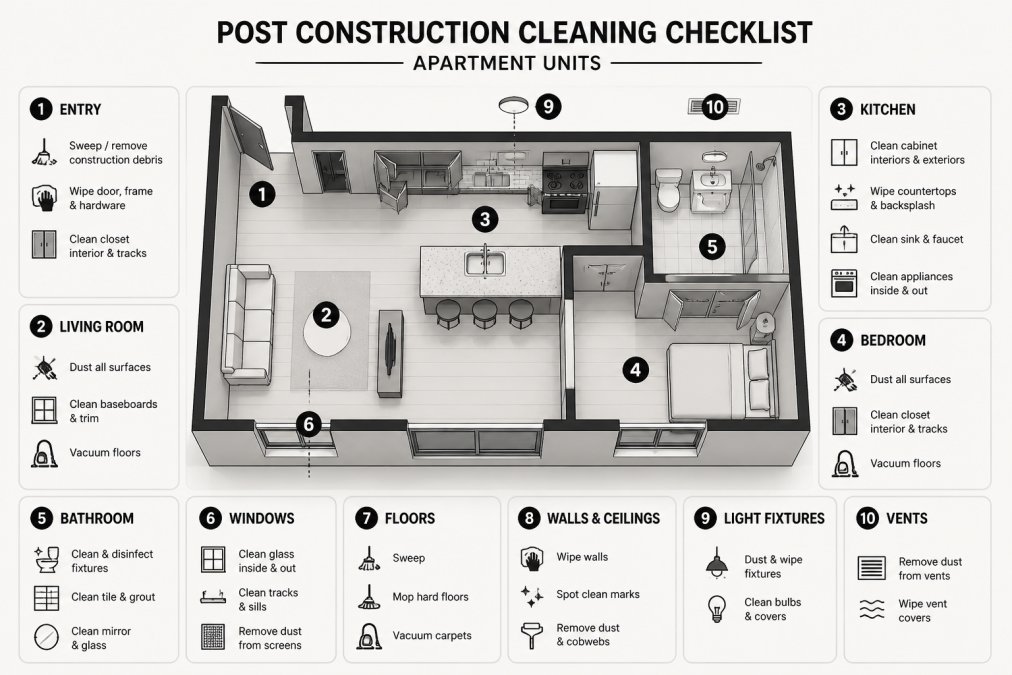
A reliable post construction cleaning checklist keeps a job from falling apart at the finish line. We use a room-by-room sequence because it prevents crews from recontaminating clean areas. Work top to bottom, back to front, and dry to wet.
Room-by-Room Checklist
Here's the sequence our crews follow on apartment turnovers:
- Entry: wipe doors, frames, and hardware; clean baseboards; sweep and mop
- Living room: dust walls and ceilings; vacuum floors; clean window tracks and glass
- Kitchen: clean cabinet interiors and exteriors; wipe countertops; degrease appliances
How to Clean Drywall Dust from Apartments
Cleaning drywall dust from apartments starts with containment, not elbow grease. If you don't stop the dust from spreading, you'll chase it from room to room all day.
Here's the process we've found works best:
Request Walk Thru Estimate Today →
- Seal the work area. Close doors and block vents so dust doesn't migrate to finished rooms.
- Work top down. Start with ceilings, then walls, then baseboards, then floors.
- Use HEPA vacuums. Standard vacuums blow fine particulate matter back into the air.
- Wipe with damp cloths, not dry rags. Damp microfiber traps dust instead of scattering it.
- Clean vents and outlets last. These collect the most dust and need a dedicated pass.
- Repeat the floors. Floors need at least two passes, once before wet cleaning and once after.
Apartment Turnover Cleaning Services: What to Expect
Apartment turnover cleaning services handle the full transition between one tenant leaving or a contractor finishing and the next tenant moving in. The goal is a move-in ready unit that passes inspection on the first walkthrough.
When you hire a professional crew, expect a site inspection first, a written scope, and a clear schedule. A coordinated vendor will confirm access, coordinate with your contractors or painters, and report completion.
| Phase | What Happens | Typical Timing |
|---|---|---|
| Site inspection | Crew assesses dust level, debris, and access | Before scheduling |
| Rough clean | Debris removal and bulk dust extraction | First pass |
| Final clean | Surface sanitization, fixtures, floors, windows | Second pass |
| Touch-up | Light dusting and detail work before showings | Day of handoff |
DIY vs. Professional Post Construction Cleaning
DIY post-construction cleaning can work for a light touch-up, a single repainted room, a swapped-out vanity, a patch-and-paint job. It falls apart on full renovations, gut rehabs, and any unit where drywall was cut, sanded, or replaced. The deciding factor is rarely effort; it's whether you can capture fine particulate matter before it recirculates.
The Health Angle Most Guides Skip
Construction dust isn't just a cosmetic problem. Drywall joint compound and sanded gypsum contain crystalline silica, and the Occupational Safety and Health Administration (OSHA) classifies respirable crystalline silica as a known health hazard linked to silicosis and other lung conditions after repeated exposure.
For a one-time DIY cleanup, a properly fitted N95 or P100 respirator, sealed doorways, and a HEPA vacuum reduce exposure.
A Simple Decision Framework
Use these thresholds to decide whether to book a crew or handle it in-house:
- Square footage of affected area: Under ~300 sq ft of light dust and debris, DIY is realistic. Over ~800 sq ft, or any unit where ceilings and walls were sanded, book a pro.
- Scope of construction: Paint touch-up and trim work, DIY. Drywall replacement, texture matching, tile work, or full gut, professional.
- Turnaround window: 48 hours or less between contractor walk-out and showing, professional. A week or more, DIY is feasible.
What DIY Actually Costs You
DIY saves the invoice but spends three other budgets: time, equipment, and risk.
- Time: A trained two-person crew typically finishes a 1-bedroom apartment in a few hours. A first-time DIY clean of the same unit commonly runs a full day or more, and often needs a second pass once dust settles.
- Equipment: A HEPA vacuum rated for fine drywall dust, microfiber kits, extension poles, and a respirator add up quickly, and most of it is single-use for a property manager.
- Risk: A missed dust trail or scratched fixture during DIY cleaning is on you. Insured and bonded crews carry that liability, which matters when a unit is under a lease obligation or a warranty inspection.
When DIY Is the Right Call
DIY is a legitimate choice for small, contained jobs: a repainted accent wall, a replaced light fixture, a single bathroom refresh. In those cases, a HEPA vacuum, damp microfiber cloths, and a top-down sequence handle the dust load fine. The moment drywall is sanded, ceilings are textured, or the unit has been under active construction for more than a few days, the math shifts toward hiring a crew, not because the work is impossible, but because the dust is fine enough to hide in places a DIY pass won't reach.
What Post Construction Cleaning Costs for Apartments
Post construction cleaning pricing depends on unit size, dust level, number of rooms, and how much construction debris remains. There's no single flat rate, because a light touch-up and a full gut renovation are completely different jobs. What most property managers want is a way to sanity-check a quote before it lands, so here's how the numbers actually break down.
The Three Pricing Models
Most providers price one of three ways:
Request Walk Thru Estimate Today →
- Flat-rate pricing per unit, based on square footage and scope. Common for standard apartment turnovers where the scope is predictable.
- Hourly rate for smaller touch-up jobs. Common when the unit is mostly clean and only a few rooms need attention.
- Project-based quotes for multi-unit buildings or phased handoffs. Common when a general contractor is still on site and the cleaning has to be sequenced around other trades.
What Actually Drives the Number
The variables that move a quote the most, in rough order of impact:
- Dust level and source. A repaint produces far less dust than a full drywall replacement. Sanded joint compound is the single biggest cost driver because it requires HEPA vacuuming, multiple wipe-downs, and often a second floor pass.
- Number of bathrooms and kitchens. Wet areas add tile scrubbing, grout cleaning, fixture polishing, and cabinet interior work, each one a line item.
- Floor type and finish. Carpet requires multiple HEPA passes; hard floors may need scrubbing, stripping, or polishing after the dust is removed.
- Debris volume and disposal. If the contractor left materials behind, haul-away and dumpster fees get added. Confirm whether disposal is included or billed separately.
- Window and track count. Window tracks collect dust and paint overspray; each window is a small job on its own.
- Access and scheduling. After-hours or weekend work, elevator reservations, and parking constraints can add labor hours.
- Turnaround window. A 24-hour rush typically carries a premium over a standard multi-day schedule.
How to Read a Quote
When you compare estimates, compare scope, not just the bottom line. A lower quote that excludes cabinet interiors, window tracks, or debris disposal isn't cheaper, it's a partial job that will need a second visit. Ask each vendor to confirm in writing:
- Whether HEPA filtration is used on every vacuum pass
- Whether cabinet and drawer interiors are included
- Whether window tracks and frames are included
- Whether debris haul-away is included
A site inspection is the fastest way to get an accurate number. Squeaky Clean Plus provides estimates based on the actual condition of your unit, not a generic rate card. For pricing on your specific property, request a quote from Squeaky Clean Plus.
Maintaining the Unit After the Deep Clean
The deep clean is the starting line, not the finish. In the weeks after a post-construction clean, dust that was trapped in vents, light fixtures, or behind appliances can settle again. A simple maintenance schedule keeps the unit showing-ready:
- Day 1 (handoff): Confirm the unit passes a white-glove walkthrough, run a finger along baseboards, window sills, and the tops of door frames.
- Week 1: Replace HVAC filters. If the system ran during construction, this is non-negotiable; a dirty filter re-seeds the whole unit.
- Week 2: Wipe down horizontal surfaces, countertops, shelves, window sills, with a damp microfiber cloth. This catches the residual dust that settles after the first week.
- Week 4: Vacuum carpets and re-mop hard floors. By this point, most airborne dust has settled and a single pass holds.
For property managers running multiple units, the real cost driver is coordination. A vendor that shows up on schedule and reports completion keeps your leasing calendar intact, and a maintenance schedule that catches residual dust early prevents the second-visit invoice that erases the savings from a low bid.
Frequently Asked Questions
What does post construction cleaning include for apartments?
Post construction cleaning for apartments covers drywall dust removal, construction debris disposal, surface sanitization, window track cleaning, cabinet interior cleaning, floor scrubbing, and fixture polishing. Crews use HEPA filtration vacuums and industrial-grade equipment to pull fine particulate matter out of vents, baseboards, and light fixtures. The goal is a move-in ready unit that passes inspection and shows well to prospective tenants.
How much can you charge for post construction cleaning?
Pricing depends on unit size, dust volume, and how many rooms need deep cleaning. Request a walkthrough quote from a professional crew so the price reflects your actual scope.
Can I do post construction cleaning myself?
You can handle light touch-ups, but full post-construction cleanup is risky without the right equipment. Drywall dust clogs standard shop vacs and spreads through the air, which can damage HVAC systems. If you attempt it, use a HEPA vacuum, change filters often, and wear a respirator. For units with heavy construction residue or tight turnover deadlines, a professional crew saves time and avoids rework.
How does post-construction cleaning differ from a standard move-out clean?
A move-out clean focuses on normal household dirt: appliances, bathrooms, floors. Post-construction cleaning adds construction debris removal, fine particulate matter extraction, drywall dust from vents and window tracks, and residue removal from paint, adhesive, and grout. It requires HEPA filtration, dust extraction tools, and often multiple passes. Standard cleaning products and vacuums are not enough for renovation cleanup.
What are the safety hazards of DIY post-construction cleaning?
Drywall dust contains fine particulate matter that irritates lungs and eyes, and construction debris can include sharp materials, nails, and silica dust. Without HEPA filtration and proper ventilation, you risk spreading dust through the building's air quality. Ladder work for light fixture cleaning and high ceilings adds fall risk. Professional crews follow safety protocols and carry insurance, which protects property managers from liability.