 how-to
Standardizing Cleaning Quality for Multi-Family Properties
Table of Contents
- Why Standardized Cleaning Quality Matters in Multifamily Housing
- Multifamily Turnover Cleaning Checklist: A Room-by-Room Standard
- Property Management Cleaning Scope of Work Template
- KPIs for Apartment Cleaning Services: Measuring What Matters
- Common Area Maintenance and Indoor Air Quality Standards
- Technology, Auditing Tools, and Green Cleaning Certifications
- Budgeting and ROI: The Financial Case for Standardization
- Frequently Asked Questions
Last Updated: September 28, 2026
Why Standardized Cleaning Quality Matters in Multifamily Housing
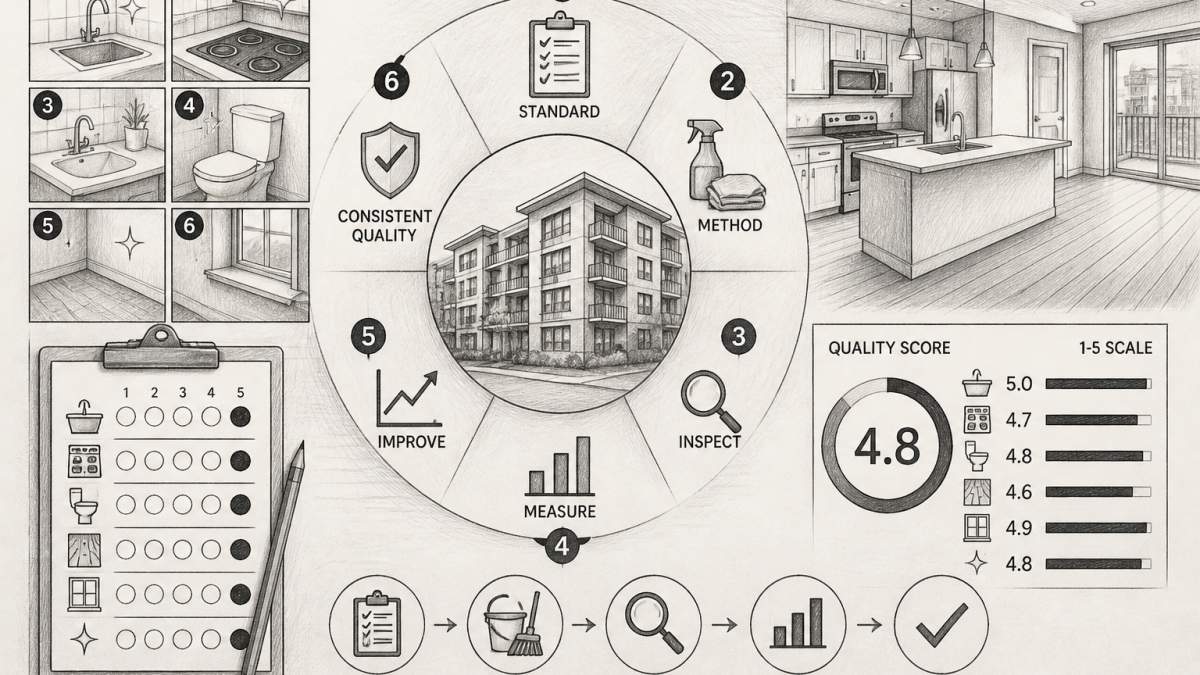
Standardizing cleaning quality for multi-family properties means every unit, hallway, and amenity gets the same documented result, no matter which crew shows up. At Squeaky Clean Plus, we see this play out daily: buildings with written standards turn units faster and field fewer complaints. Without them, quality drifts from unit to unit.
Multifamily Turnover Cleaning Checklist: A Room-by-Room Standard
A multifamily turnover cleaning checklist is a room-by-room document that lists every surface, fixture, and finish a crew must clean before a unit is marked move-in ready. It turns "clean enough" into a pass-or-fail standard anyone can inspect.
Kitchen and Bathroom Deep Clean Standards
Kitchens and bathrooms decide whether a unit shows well. These rooms carry the highest cleaning risk and the most resident complaints.
- Degrease range hoods, backsplashes, and cabinet fronts
- Clean inside the oven, microwave, and refrigerator
- Descale sinks, faucets, and showerheads
- Scrub grout lines and re-caulk where needed
- Disinfect toilets, tubs, and vanities, then dry-buff all fixtures
Living Areas, Bedrooms, and Entryways
These spaces are mostly about dust, floors, and first impressions.
- Wipe baseboards, door frames, and light switches
- Clean windows, tracks, and blinds
- Vacuum carpets and mop hard floors
- Remove scuffs from walls and doors
- Sweep and rinse entryways and patios
Property Management Cleaning Scope of Work Template
A property management cleaning scope of work template is a written agreement that defines exactly what gets cleaned, how often, and to what standard. It removes guesswork for both the property team and the vendor.
Use this structure for each property:
- Property details: address, unit count, square footage, building layout
- Cleaning tasks: routine tasks, deep cleaning tasks, and turnover tasks listed separately
- Frequency: daily, weekly, monthly, and per-turnover schedules
- Standards: what "pass" looks like for each task
- Supplies and equipment: who provides what
- Reporting: inspection cadence and issue escalation path
- Terms: start date, renewal, and termination conditions
KPIs for Apartment Cleaning Services: Measuring What Matters
KPIs for apartment cleaning services are the numbers that show whether your standard is actually being met. Track four or five, no more, or the data becomes noise.
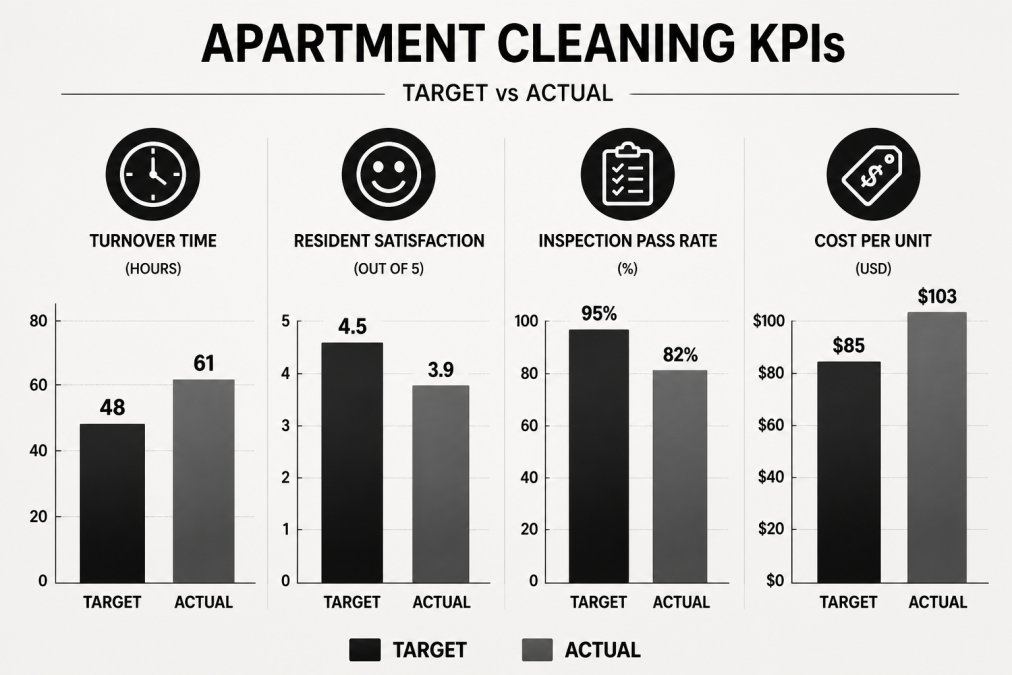
| KPI | What It Tracks | Target Example |
|---|---|---|
| Turnover time | Hours from move-out to ready | 48 hours |
| Inspection pass rate | Units passing first inspection | 95% |
| Resident satisfaction | Survey score after service | 4.5 / 5 |
| Cost per unit | Total cleaning spend per unit | Set by budget |
| Rework rate | Units needing a second visit | Under 5% |
Common Area Maintenance and Indoor Air Quality Standards
Common area maintenance covers everything residents share: lobbies, hallways, stairwells, elevators, laundry rooms, gyms, and mail areas. These spaces shape how residents and prospects judge the whole property.
- Vacuum carpets with HEPA filtration
- Wipe vents and replace filters on schedule
- Watch for moisture and mold in laundry and pool areas
- Clean high-touch surfaces like handrails and door handles daily
- Log every inspection so patterns show up early
Technology, Auditing Tools, and Green Cleaning Certifications
Technology and auditing tools turn cleaning from a verbal promise into a record you can check. The competitive gap here is real: most articles tell property managers to "inspect regularly" and stop there. What follows is the actual stack, in the order most teams adopt it, with the trade-offs at each step.
Layer 1: Digital Checklists With Photo Evidence
The entry point is replacing paper clipboards with a mobile checklist app. Each task gets a checkbox and a required photo. The photo is the mechanism that matters, it converts "I cleaned the oven" into a timestamped image a manager can review without walking the unit.
Layer 2: QR Codes for On-Site Verification
A QR code on each unit door or common-area entrance lets staff scan in when they arrive and scan out when they finish. This creates a location-and-time record that a checklist alone cannot. The practical benefit is dispute resolution: when a resident claims a hallway was skipped, the scan log answers the question in seconds.
Layer 3: Inspection Apps With Scoring
Inspection apps let a supervisor score each unit against the same rubric and flag fails automatically. The scoring rubric is the important part, it should mirror the pass-or-fail standards in your scope of work, so a score of 90 means the same thing at every building.
Layer 4: Dashboards and Trend Tracking
Once inspections are digital, dashboards track pass rates by building, by crew, and by task type. This is where standardization becomes self-correcting: if one crew consistently fails bathroom grout, the dashboard surfaces it before residents do.
IoT Sensors: Where They Fit (and Where They Don't)
IoT sensors are the newest layer and the least proven for routine multifamily cleaning. Practical uses today include restroom occupancy and supply sensors that trigger cleaning when traffic thresholds are hit, and moisture sensors in laundry and pool areas that flag conditions before mold develops. They are not yet a substitute for human inspection of unit interiors.
Request Walk Thru Estimate Today →
Green Cleaning Certifications That Carry Weight
On the green side, third-party certifications give you a verifiable standard instead of a marketing claim. Green Seal's certification standards for cleaning products and services and EPA Safer Choice both let you confirm a product's claims rather than trusting a label. For building-level recognition, EPA's ENERGY STAR and indoor air quality resources and green building rating systems recognize documented cleaning and IAQ practices, useful when ownership markets a property as healthy or sustainable.
Budgeting and ROI: The Financial Case for Standardization
Standardization pays for itself through faster turns and fewer rework visits. But "it pays for itself" is not a budget line. What follows is a calculation model property managers can actually run, plus the cost drivers that move the number most.
Step 1: Build the True Cost Per Unit
Start with the fully loaded cost of cleaning one unit, not just the invoice. Include:
- Labor or vendor rate for routine, deep, and turnover cleaning, priced separately
- Supplies and equipment, who buys them, and at what per-unit cost
- Supervision and inspection time, the hours a manager spends checking work
- Rework cost, the second visit when a unit fails inspection
- Lost rent days, the daily rent value of every day a unit sits vacant past its target turn time
Step 2: Quantify the Rework Tax
Rework is the clearest, most controllable cost. If 15% of turns need a second visit, and a second visit costs roughly the same as the first, you are paying about 15% more than your invoice suggests. Standardization attacks this directly: a written checklist with photo evidence typically pushes rework down because the first visit is measured against a pass-or-fail standard instead of a verbal expectation.
Step 3: Price the Vacancy Cost of Slow Turns
Every day a unit is not rent-ready is a day of lost rent. Multiply the daily rent by the number of days the turn runs past target. If your target is 48 hours and the actual is 61, that is 13 days of lost rent per unit, the single largest line item in most standardization business cases.
Step 4: Compare In-House vs. Outsourced on Total Cost, Not Rate
In-house cleaning looks cheaper on an hourly basis but carries hidden costs: recruiting, training, turnover, benefits, equipment, and management time. Outsourced cleaning looks more expensive per hour but bundles supervision, supplies, and coverage. The right comparison is total cost per unit at a defined quality standard, not the hourly rate.
A practical framework:
| Cost Driver | In-House | Outsourced |
|---|---|---|
| Hourly rate | Lower | Higher |
| Recruiting and training | Carried by property | Carried by vendor |
| Supplies and equipment | Carried by property | Usually bundled |
| Supervision | Manager time | Vendor supervisor |
| Coverage during turnover spikes | Limited by headcount | Scales with contract |
| Quality consistency | Depends on crew | Depends on vendor's SOPs |
Step 5: Calculate Payback
Add the savings from reduced rework and reduced vacancy days, then compare against the cost of implementing standardization (checklist development, inspection tooling, training time). Most property teams find payback arrives within the first few turnover cycles, because the vacancy-day savings alone often exceed the implementation cost.
Frequently Asked Questions
What is the 5 5 5 rule for cleaning?
The 5 5 5 rule is a simple framework: clean for 5 minutes in each of 5 key zones, 5 times per week. In multifamily properties, it helps maintenance teams maintain common areas without long blocks of time. Zones might include lobby, elevator, mailroom, fitness center, and laundry room. This routine prevents dirt buildup and keeps resident-facing spaces consistently presentable between deeper cleanings.
How do you measure cleaning quality in large apartment communities?
Use KPIs for apartment cleaning services such as inspection scores, resident satisfaction surveys, and turnover time. Conduct regular site inspections with a standardized checklist, track the percentage of units passing quality assurance on the first try, and monitor response time to cleaning requests. These metrics give property managers objective data to compare vendors and identify areas needing improvement.
What should be included in a professional multifamily cleaning scope of work?
A property management cleaning scope of work template should list all areas covered (units, common areas, exteriors), specific tasks per area, frequency (daily, weekly, turnover), cleaning products and equipment requirements, safety and compliance standards, and reporting expectations. It should also define quality benchmarks, communication protocols, and consequences for missed tasks. This clarity prevents disputes and ensures consistent service.
Do landlords need to professionally clean between tenants?
While not legally required in most states, professional cleaning between tenants is a best practice that protects property value and reduces turnover time. A thorough multifamily turnover cleaning checklist ensures units are move-in ready, which can increase resident satisfaction and retention. Many property management companies include professional cleaning in their standard turnover process to maintain consistent quality across all units.
Cleaning quality drifts the moment it depends on memory instead of a checklist. Squeaky Clean Plus builds that standard into every job, with dedicated project coordination, a focus on the turnover handoff process, and a track record as a supplier partner with the Apartment Association of Metro Denver. If your units need to be ready on a tight schedule, get an estimate and see how a coordinated turnover process keeps your projects on track.